Here’s the uncomfortable truth: Your balance sheet is lying to you.
Not intentionally. But if you’re valuing equipment at historical cost while replacement costs have jumped 15% due to inflation, or if you’re expensing all R&D while your competitors are capitalizing software development under ASC 985-20, your financial statements don’t reflect reality. And in 2026, with SBA lenders requiring third-party IP appraisals for loans over $250K and the IRS using AI-driven analytics to spot depreciation anomalies, “close enough” gets you denied funding or audited.
This guide is built for CFOs and founders who need actionable frameworks, not theory. We’ll cover:
- How to maintain three parallel valuations (GAAP, Tax, Lender) without losing your mind
- Exact Section 179 and Bonus Depreciation limits for 2026 (with phase-out thresholds)
- Step-by-step DCF model for valuing AI models and proprietary datasets
- Real case study: SaaS startup Series A showing GAAP vs Tax vs Lender balance sheets side-by-side
- Downloadable templates: Book-Tax reconciliation schedule, Fixed Asset Register, IP impairment checklist
The Three-Book Problem: Why One Asset Has Three Values
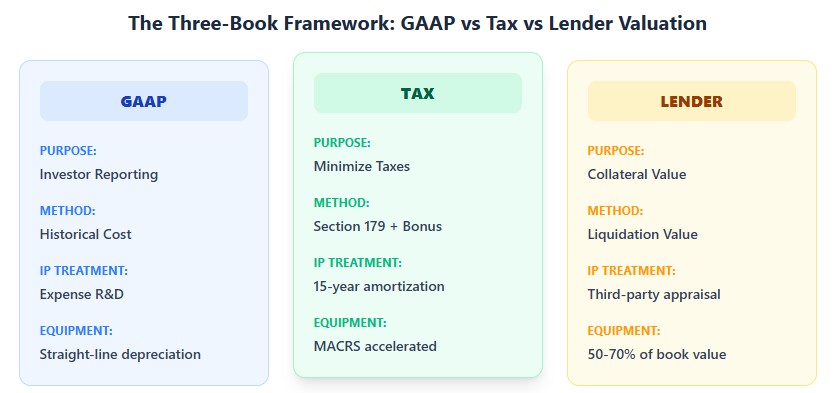
You’re not maintaining one balance sheet. You’re maintaining three:
Book 1: GAAP (For Investors & Financial Reporting)
Conservative, historical cost-based, focused on reliability. Internally developed IP? Generally expensed. Equipment? Depreciated over economic useful life using straight-line.
Book 2: IRS Tax (For Minimizing Taxes)
Aggressive deductions. Section 179 allows expensing up to $2.89M in 2026 (up from $1.16M in 2023). Bonus depreciation is 100% for qualified property placed in service after 2025 (per the Tax Cuts and Jobs Act sunset provisions). But California adds back bonus depreciation on state returns.
Book 3: Lender Valuation (For Getting Loans)
Liquidation value, not book value. That $500K server cluster? Worth $250K max in a fire sale. Your proprietary AI model? Worth $0 unless you have a third-party appraisal and proven revenue attribution.
The CFO Strategy: Maintain a Book-Tax Difference Schedule (download template below). Reconcile quarterly. Never mix these valuations in investor presentations.
Equipment Valuation: 2026 Rules and Real Numbers
Inflation has broken the old rules. A $2,500 capitalization threshold made sense in 2020. In 2026, a MacBook Pro costs $3,800. Here’s how to adapt.
What Gets Capitalized (The Complete List)
Under GAAP (ASC 360), capitalize all costs necessary to get the asset ready for its intended use:
- Purchase price
- Sales tax (non-deductible portion)
- Freight and shipping
- Installation and calibration
- Testing costs (materials consumed during testing)
- Professional fees (engineering, legal for installation contracts)
Real Example: You purchase a CNC machine for $150,000. Shipping: $4,500. Installation: $8,000. Calibration materials: $2,500. Legal fees for installation contract: $3,000.
Correct Asset Value: $168,000. Not $150,000.
2026 Depreciation: GAAP vs Tax Comparison
| Feature | GAAP (ASC 360) | IRS Tax (2026) | Book-Tax Difference |
|---|---|---|---|
| Method | Straight-line (typically) | MACRS 200% DB or Section 179 | Timing difference |
| Useful Life | Economic life (5-7 years for tech) | IRS Class Life (5-year for computers) | Potential permanent difference |
| Section 179 Limit | N/A | $2.89M (2026), phases out at $4.12M | Accelerated deduction |
| Bonus Depreciation | N/A | 100% for qualified property (post-2025) | Full expensing vs multi-year |
| Salvage Value | Subtracted from depreciable base | Ignored under MACRS | Permanent difference |
Case Study: Hardware Startup Equipment Strategy
Company: Robotics manufacturer, Series A, $8M revenue
Equipment: $450K in CNC machines, $120K in testing equipment, $85K in computers
GAAP Treatment:
- CNC machines: 7-year straight-line, $64,286/year depreciation
- Testing equipment: 5-year straight-line, $24,000/year
- Computers: 3-year straight-line, $28,333/year
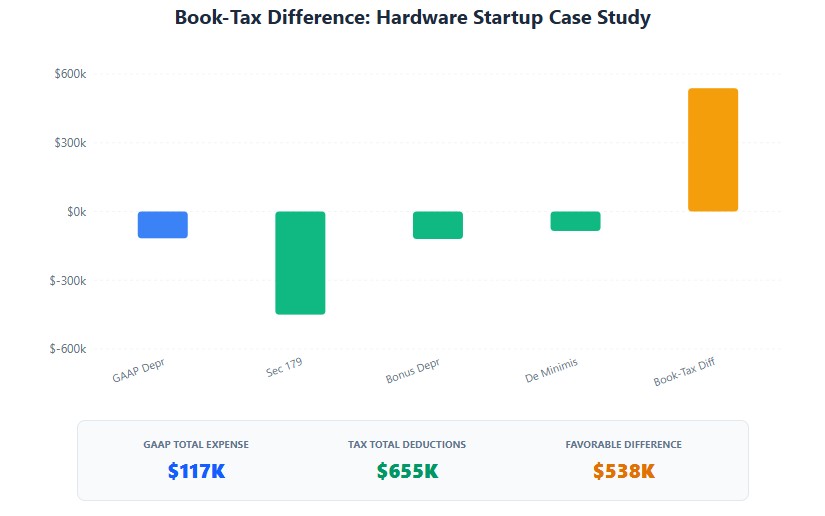
- Total Year 1 GAAP Depreciation: $116,619
Tax Treatment (Maximizing Deductions):
- Elect Section 179 on CNC machines: $450K immediate deduction
- Bonus depreciation (100%) on testing equipment: $120K immediate deduction
- Computers under de minimis safe harbor ($2,500 threshold): Expense $85K
- Total Year 1 Tax Deduction: $655,000
Book-Tax Difference: $655,000 – $116,619 = $538,381 favorable temporary difference
Lender View (SBA 7(a) Application):
- Equipment appraised at 60% of book value (ordered liquidation value)
- CNC machines: $270,000 collateral value
- Testing equipment: $72,000 collateral value
- Computers: $0 (too specialized/rapid obsolescence)
- Total Collateral Value: $342,000 (vs $655,000 book cost)
Strategic Insight: The startup maximizes tax deductions while maintaining clean GAAP books for investors. But when applying for an SBA loan, they can only borrow against 52% of their equipment cost. This gap must be bridged with other collateral or personal guarantees.
Intellectual Property Valuation: The 2026 Framework
IP valuation has changed dramatically. In 2023, a self-prepared valuation might suffice. In 2026, SBA lenders and Series A investors require third-party appraisals for IP over $250K, especially for AI models and proprietary datasets.
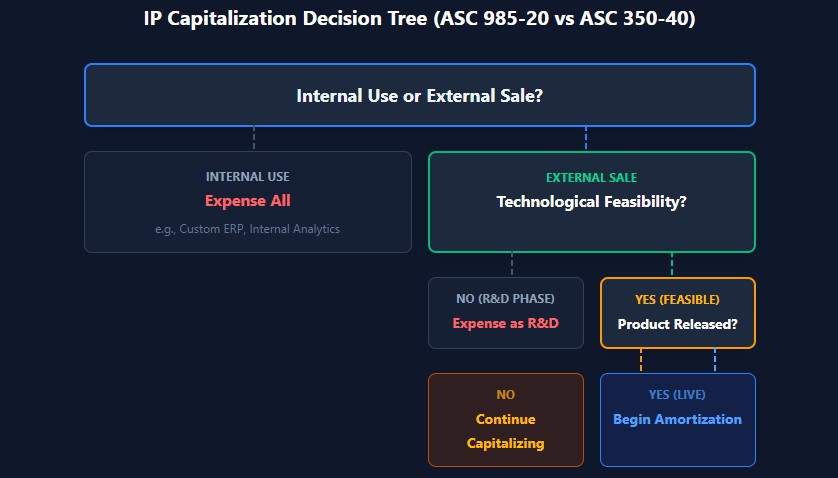
When Can You Capitalize IP? (Decision Tree)
Step 1: Is the IP for internal use or external sale?
- Internal Use (ASC 350-40): Expense all development costs. Examples: Internal ERP, custom CRM, proprietary data analytics tools.
- External Sale/Lease (ASC 985-20): Continue to Step 2.
Step 2: Has technological feasibility been established?
- No: Expense all costs as R&D.
- Yes: Capitalize direct development costs (developer salaries, cloud infrastructure for testing, third-party contractors).
Step 3: Has the product been released?
- No: Continue capitalizing.
- Yes: Stop capitalizing. Begin amortization over useful life (typically 3-5 years for software).
Documentation Required:
- Working prototype with test results
- Technical feasibility sign-off from CTO/lead engineer
- Time tracking logs for capitalized hours
- Cloud infrastructure costs allocated to development vs production
Three Valuation Methods (With 2026 Examples)
1. Cost Approach (The Floor)
Formula: (Development Hours × Market Rate) + Legal Fees + Testing Costs + Overhead Allocation
Example: Proprietary AI recommendation engine
- Senior ML Engineer: 800 hours × $175/hour = $140,000
- Junior Engineer: 1,200 hours × $95/hour = $114,000
- Cloud infrastructure (AWS SageMaker): $28,000
- Legal fees (patent filing): $18,000
- Testing/QA: $15,000
- Total Cost: $315,000
When to Use: Early-stage IP with no revenue. Sets the minimum value.
Limitation: Doesn’t reflect market value. A failed product cost money but is worth $0.
2. Market Approach (The Benchmark)
Formula: Comparable Licensing Deals × Revenue Multiple or Royalty Rate
Example: SaaS platform with $2M ARR
- Comparable SaaS acquisitions trade at 8-12× ARR
- Midpoint: 10× $2M = $20M enterprise value
- IP represents 60% of value (rest is team, customers, brand)
- IP Value: $12M
When to Use: M&A transactions, investor valuations.
Limitation: Requires comparable transactions. Hard for unique AI models.
3. Income Approach (The Gold Standard for 2026)
Formula: DCF of IP-Attributable Cash Flows, Discounted at Risk-Adjusted Rate
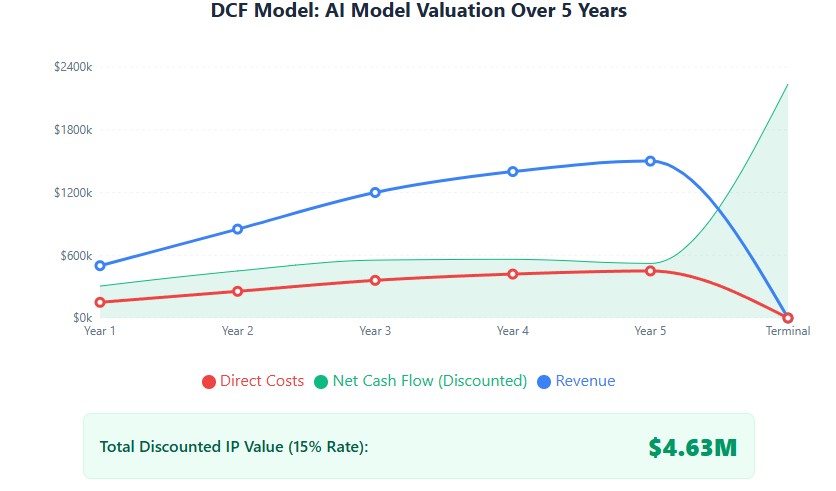
Step-by-Step DCF Model:
| Year | IP Revenue | Direct Costs | Net Cash Flow | Discount Factor (15%) | PV |
|---|---|---|---|---|---|
| Year 1 | $500,000 | $150,000 | $350,000 | 0.870 | $304,500 |
| Year 2 | $850,000 | $255,000 | $595,000 | 0.756 | $449,820 |
| Year 3 | $1,200,000 | $360,000 | $840,000 | 0.658 | $552,720 |
| Year 4 | $1,400,000 | $420,000 | $980,000 | 0.572 | $560,560 |
| Year 5 | $1,500,000 | $450,000 | $1,050,000 | 0.497 | $521,850 |
| Terminal Value (Year 5 × 3× multiple) | 0.497 | $2,236,500 | |||
| Total IP Value (Sum of PV) | $4,625,950 | ||||
Key Assumptions:
- Revenue growth: 70% → 41% → 17% → 7% (maturing product)
- Direct costs: 30% of revenue (cloud infrastructure, support)
- Discount rate: 15% (startup risk premium)
- Terminal multiple: 3× (conservative for established IP)
- Useful life: 5 years (software obsolescence)
When to Use: SBA loans, Series A+ fundraising, M&A. This is what lenders and investors expect in 2026.
2026 Trend: AI Model and Dataset Valuation
Traditional IP valuation doesn’t work for AI models. Here’s what lenders are asking for:
Required Documentation:
- Training Cost Breakdown: GPU hours, data acquisition costs, engineer time
- Performance Metrics: Accuracy, precision, recall compared to benchmarks
- Revenue Attribution: What % of revenue is directly attributable to the AI model? (Use A/B testing data)
- Defensibility: Patents, trade secrets, data moats
- Third-Party Appraisal: Required for loans >$250K. Use ASA (American Society of Appraisers) certified professionals.
Case Study: Fintech startup with proprietary fraud detection AI
Model: Neural network trained on 5M transactions
Valuation Method: Income approach with A/B testing validation
Result: Model reduces fraud by 0.3%, saving $2M/year. Capitalized value: $8.5M (4.25× annual savings, 5-year life, 15% discount rate).
Impairment Testing: When to Write Down Assets
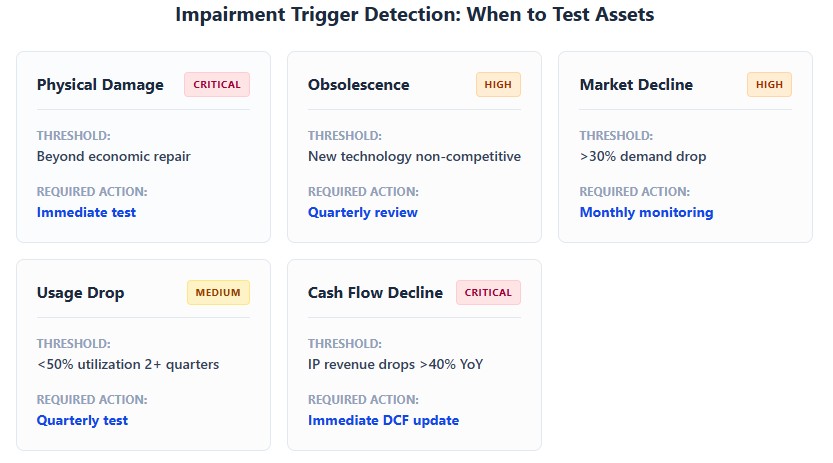
You don’t test annually. You test when triggering events occur. Missing these is a common audit flag.
Triggering Events (ASC 360-10-35)
- Physical Damage: Equipment destroyed or damaged beyond economic repair
- Obsolescence: New technology makes your asset non-competitive (e.g., CPU architecture shift)
- Market Decline: >30% drop in demand for products using the asset
- Regulatory Change: New laws restrict or ban your technology
- Usage Drop: Equipment utilization falls below 50% for 2+ consecutive quarters
- Cash Flow Decline: IP-attributable revenue drops >40% YoY
Impairment Test Process
Step 1: Recoverability Test
Compare Asset Carrying Value to Undiscounted Future Cash Flows.
Example: Patent with $400K book value
– Expected cash flows (undiscounted): $350K
– Result: Impaired (cash flows < carrying value)
Step 2: Measurement
Write down to Fair Market Value.
Example (continued):
– Carrying value: $400K
– Fair value (appraisal): $280K
– Impairment loss: $120K (recognized on P&L)
Book-Tax Reconciliation: The 2026 Template
This is the document your CPA needs. Maintain it quarterly.
| Item | GAAP Book | Tax Return | Difference | Type |
|---|---|---|---|---|
| Equipment Depreciation | ||||
| CNC Machines | ($64,286) | ($450,000) | $385,714 | Temporary |
| Testing Equipment | ($24,000) | ($120,000) | $96,000 | Temporary |
| Computers | ($28,333) | ($85,000) | $56,667 | Temporary |
| Software Development | ||||
| R&D Expenses | ($450,000) | ($450,000) | $0 | None |
| Capitalized Software | $180,000 | $0 | $180,000 | Temporary |
| Net Book-Tax Difference | $718,981 |
Deferred Tax Liability: $718,981 × 21% = $150,986
State-Specific Compliance: California, Texas, Delaware
California: The Conformity Trap
Issue: California does NOT conform to federal bonus depreciation or Section 179 limits.
Impact: If you expense $450K under Section 179 federally, you must add it back on California Form 3885A and depreciate it over 5-7 years for state tax.
2026 California Limits:
- Section 179: $25,000 (vs $2.89M federal)
- Bonus depreciation: Not allowed
- Result: Massive book-tax difference requiring detailed tracking
Texas: Franchise Tax Nuances
Issue: Texas franchise tax is based on margin, not income. Equipment depreciation affects your cost of goods sold calculation.
Strategy: Maximize COGS by properly capitalizing equipment used in production. This reduces your taxable margin.
Delaware: IP Holding Strategy
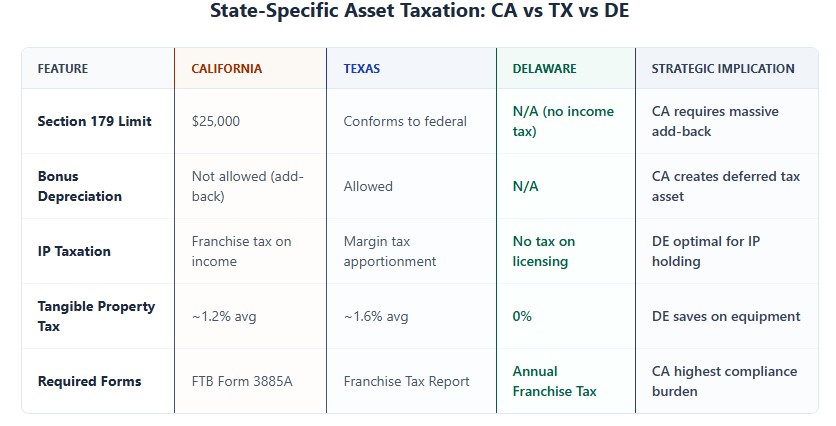
Advantage: No tangible personal property tax. No state income tax on IP licensing revenue if structured correctly.
Warning: If you hold IP in a Delaware LLC but operate in California, California may still tax the income under “economic nexus” rules.
Federal Audit Risks: What the IRS Actually Looks For
The IRS uses the Audit Technique Guide for Intangibles (ATG-12B). Here are the top triggers:
Top 5 Audit Triggers
- Missing Form 4562: If you claim depreciation or Section 179, you MUST file Form 4562. No exceptions. Missing form = automatic disallowance.
- Capitalized R&D Without Documentation: You capitalized $200K in software development but can’t produce:
- Technological feasibility documentation
- Time tracking logs
- Cloud infrastructure allocation
- Inconsistent Useful Lives: Depreciating laptops over 10 years to boost profit. IRS expects 5 years under MACRS. Result: Adjustment + interest.
- Section 179 Exceeding Income: You claimed $500K Section 179 but only had $300K taxable income. You must carry forward the excess. Failure to track = audit flag.
- IP Valuation Without Appraisal: You put $2M IP on the balance sheet with no third-party appraisal. Lenders and auditors will question this.
Decision Tools and Templates
Decision Tree: Capitalize vs. Expense
Equipment:
- Cost > $2,500 (or your capitalization threshold)? → Yes → Capitalize
- Cost < $2,500? → Expense under de minimis safe harbor (Rev. Proc. 2015-54)
Software Development:
- Internal use (ASC 350-40)? → Expense all costs
- External sale (ASC 985-20)? → Continue
- Technological feasibility established? → No → Expense | Yes → Capitalize
- Product released? → No → Continue capitalizing | Yes → Begin amortization
Checklist: SBA 7(a) Loan Asset Documentation
Before applying, ensure you have:
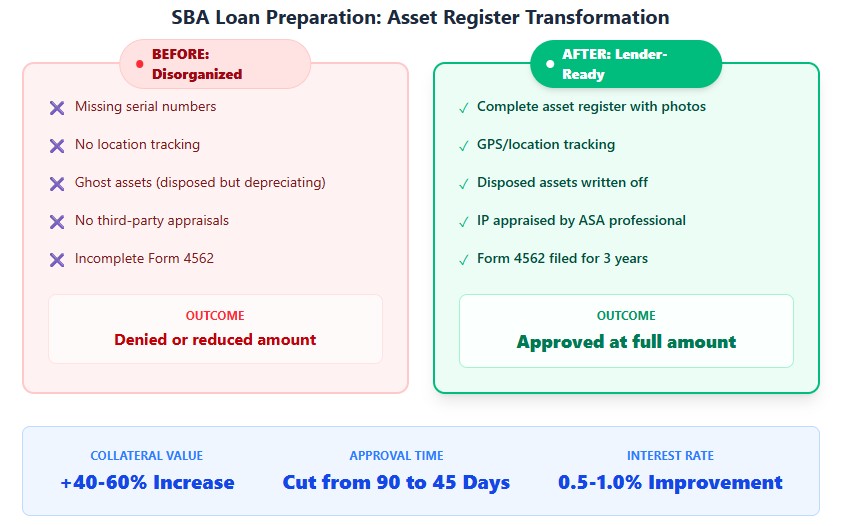
- [ ] Fixed Asset Register with serial numbers, locations, purchase dates
- [ ] Form 4562 filings for last 3 years
- [ ] Third-party appraisal for IP >$250K (ASA certified)
- [ ] Equipment insurance policies with replacement cost coverage
- [ ] Book-Tax reconciliation schedule
- [ ] Impairment testing documentation (if applicable)
- [ ] State tax clearance letters (CA, TX, NY if applicable)
- [ ] Purchase invoices and proof of payment for all assets >$10K
30-Day Action Plan for CFOs
Week 1: Audit Your Fixed Asset Register
- Export asset list from QuickBooks/Xero
- Physically verify equipment >$5K exists
- Identify “ghost assets” (still depreciating but disposed)
- Update capitalization threshold to $5K for 2026
Week 2: Review IP Classification
- List all internally developed software/patents
- Apply capitalize vs. expense decision tree
- Ensure legal fees for patents are capitalized
- Document technological feasibility for any capitalized software
Week 3: Prepare Book-Tax Reconciliation
- Work with CPA to prepare Form 4562
- Calculate deferred tax liabilities
- Review state conformity issues (especially CA)
- Update depreciation schedules for 2026 limits
Week 4: Lender/Investor Preparation
- Get equipment replacement cost quotes (for insurance)
- Engage third-party appraiser for IP >$250K
- Prepare lender valuation schedule (liquidation values)
- Update balance sheet notes with valuation methodologies
Final Thoughts
Valuing equipment and IP isn’t just compliance. It’s strategy. The startups that win in 2026 are those that:
- Maintain clean parallel books (GAAP, Tax, Lender)
- Maximize tax deductions without compromising GAAP integrity
- Document IP valuations with third-party appraisals
- Test for impairment proactively, not reactively
- Use book-tax differences as a strategic tool, not a burden
Your balance sheet tells a story. Make sure it’s the story you want investors, lenders, and the IRS to hear.