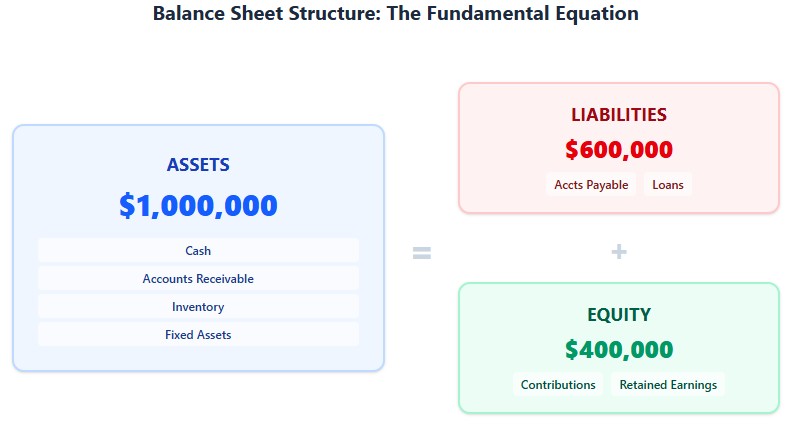
A balance sheet shows what a company owns (assets), what it owes (liabilities), and what is left for its owners (equity) on a specific date. The equation is simple: assets must equal liabilities plus equity. The useful question is less simple: if the business has a bad quarter, can it get through it without outside help?
This guide follows one fictional business from the basic balance sheet equation to a bank covenant test: Ridgeline Fabrication LLC, a metal fabricator with $4.8 million in revenue and 22 employees. Any figure marked as a planning range or estimate is a practitioner assumption, not a published industry statistic. Published references are linked where available.
What does a balance sheet show?
Think of the balance sheet as a snapshot. An income statement covers a period, such as a quarter or a year; the cash flow statement tracks how cash moved during that period. The balance sheet shows where the business stood at the end.
- Assets: cash, accounts receivable (A/R), inventory, prepaid expenses, equipment, buildings, goodwill.
- Liabilities: accounts payable (A/P), accrued expenses, credit lines, term loans, deferred revenue.
- Equity: paid-in capital plus retained earnings (all past profit that was not paid out).
Assets = Liabilities + Equity. If the two sides do not match, something is missing or has been posted to the wrong account.
A balance sheet also has blind spots. It does not show profit over time or when cash will actually arrive. Most assets are recorded at cost rather than current market value, and potential commitments—such as backlog, pending lawsuits, or a customer contract that may not renew—may not appear as liabilities yet.
Balance sheet format and example
In a US balance sheet, assets are generally listed by liquidity: cash first, followed by receivables and inventory, then longer-lived assets. The main distinction is between current items, expected to turn into cash or be paid within 12 months or one operating cycle, and non-current items.
Ridgeline Fabrication LLC: balance sheet, December 31 (USD thousands)
| Line | 2025 | 2024 |
|---|---|---|
| Cash | 180 | 293 |
| Accounts receivable (incl. $45K due from an affiliate) | 590 | 480 |
| Inventory | 520 | 430 |
| Prepaid expenses | 30 | 25 |
| Total current assets | 1,320 | 1,228 |
| Property and equipment, gross | 1,640 | 1,510 |
| Accumulated depreciation | (660) | (570) |
| Property and equipment, net | 980 | 940 |
| Goodwill | 100 | 100 |
| Total assets | 2,400 | 2,268 |
| Accounts payable | 330 | 290 |
| Accrued expenses | 90 | 80 |
| Revolving line of credit | 160 | 100 |
| Current portion of term debt | 120 | 110 |
| Total current liabilities | 700 | 580 |
| Term debt, non-current | 780 | 900 |
| Total liabilities | 1,480 | 1,480 |
| Paid-in capital | 200 | 200 |
| Retained earnings | 720 | 588 |
| Total equity | 920 | 788 |
| Total liabilities and equity | 2,400 | 2,268 |
How to read a balance sheet: a six-step sequence
Ridgeline earned $252K in 2025, so the business may look healthy at first glance. Read the balance sheet in this order—liquidity, asset quality, debt maturity, capital, trends, and finally cash reconciliation—and a more complicated picture emerges:
| Step | Question | Lines to check | Ridgeline |
|---|---|---|---|
| 1. Liquidity | Can it pay what is due within 12 months? | Cash, current assets and liabilities; current, quick and cash ratios | Current ratio fell from 2.12x to 1.89x; cash fell 39% ($293K to $180K) in a profitable year |
| 2. Asset quality | Will the current assets really turn into cash? | A/R aging, inventory aging, owner and affiliate balances | $60K of A/R is over 90 days past due, $70K of stock has not moved in 12 months, $45K of “receivables” is owed by an affiliate |
| 3. Debt maturity | How much debt falls due soon, and how is it funded? | Revolver, current portion of term debt, undrawn credit | Short-term obligations rose from 39% to 47% of total liabilities ($580K to $700K), mostly through the revolver; total liabilities did not change ($1,480K) |
| 4. Capital | Where did the equity come from? | Retained earnings roll-forward, paid-in capital, write-downs | Equity rose $132K, all from retained profit (252 − 120 distributions); no new capital |
| 5. Trend | Which lines grow faster than sales? | A/R, inventory, payables against revenue growth | A/R +23% and inventory +21% while sales grew about 9% (2024 revenue: $4.40M) |
| 6. Cash reconciliation | Does profit turn into cash? | Indirect cash flow bridge, closing cash | $252K of profit produced $187K of operating cash (see the bridge below) |
A ratio is a signal, not a verdict
Two businesses can report the same current ratio and still carry very different risks. Both companies below show 1.89x: $1,320K in current assets divided by $700K in current liabilities. The final row applies typical asset-based lending advance rates—85% for eligible receivables and about 50% for eligible inventory. Receivables more than 90 days overdue, affiliate balances, and stock that has not moved for over a year are excluded. These are planning assumptions, not universal lender rules.
| Current assets ($K) | Ridgeline | Company B |
|---|---|---|
| Cash | 180 | 600 |
| Receivables (Ridgeline: $545K trade + $45K affiliate) | 590 | 420, all under 60 days |
| Inventory | 520 | 270 |
| Prepaids | 30 | 30 |
| Current ratio | 1.89x | 1.89x |
| Quick ratio | 1.10x | 1.46x |
| Borrowing-base-adjusted current ratio | 1.17x (180 + 485 × 85% + 450 × 50% = 817) | 1.56x (600 + 420 × 85% + 270 × 50% = 1,092) |
The adjusted ratio gets closer to the question a lender actually cares about: if the company had to borrow against or liquidate working capital, how much of its current liabilities could it cover? For Ridgeline, the answer is 1.17x. Read it alongside the reported ratio as a stress test, not a replacement.
Line-by-line rules that change your ratios
- Contra accounts: accumulated depreciation, the allowance for doubtful accounts and the inventory reserve are subtracted from the asset they relate to. Without them, assets are overstated.
- Current portion of long-term debt is the principal due within 12 months. Leaving it in the long-term line inflates the current ratio.
- A revolving line of credit is normally a current liability. Treating the $160K revolver as long-term would lift Ridgeline’s current ratio from 1.89x to 2.44x (1,320 / 540). Banks usually reclassify revolvers that mature within a year or that are repaid from a lockbox.
- Owner and affiliate balances (money the owner took out, or an affiliate owes the company) are not trade receivables. Lenders move them out of current assets and often deduct them from tangible net worth.
- Cash-basis books have no A/R or A/P. A cash-basis “balance sheet” cannot be used to calculate DSO, DPO or a meaningful current ratio. Banks ask for an accrual conversion, often prepared or reviewed by a CPA.
How the balance sheet connects to the income statement and cash flow
Here is Ridgeline’s 2025 income statement, in USD thousands: revenue 4,800; cost of goods sold 3,120; gross profit 1,680 (35.0%); operating expenses before depreciation 1,290; depreciation 90; operating income 300; interest 48; and net income 252. The LLC is taxed as a pass-through, so there is no entity-level income tax in this example. EBITDA is 390 (300 + 90).
Use these six steps to reconcile the income statement, balance sheet, and cash flow statement. If a number fails to tie, stop and find the reason before relying on the statements:
- Net income goes into retained earnings: 588 + 252 − 120 owner distributions = 720, which matches the balance sheet.
- Add back non-cash expenses (depreciation 90). Accumulated depreciation rose by the same 90.
- Subtract increases in operating assets and add increases in operating liabilities (receivables, inventory, prepaids, payables, accruals). Each equals the change between the two balance sheets.
- Operating cash flow is the result.
- Capital spending and financing follow. Equipment purchases equal the change in gross property and equipment (1,640 − 1,510 = 130); debt and distributions come from the debt and equity lines.
- Closing cash must equal cash on the balance sheet.
| Item | USD thousands |
|---|---|
| Net income | 252 |
| + Depreciation (non-cash) | 90 |
| − Increase in receivables | (110) |
| − Increase in inventory | (90) |
| − Increase in prepaids | (5) |
| + Increase in payables | 40 |
| + Increase in accrued expenses | 10 |
| Operating cash flow | 187 |
| − Equipment purchases | (130) |
| Free cash flow | 57 |
| − Term debt repaid | (110) |
| + Revolver drawn | 60 |
| − Owner distributions | (120) |
| Net change in cash | (113) |
| Opening cash 293 − 113 = closing cash | 180 (ties to the balance sheet) |
Profit-to-cash conversion—operating cash flow divided by net income—is 187 / 252, or 0.74. Working capital absorbed $155K (110 + 90 + 5 − 40 − 10); the $90K depreciation add-back offsets part of that use of cash, leaving a $65K gap. A result below roughly 0.8 is a reason to inspect working capital, not proof that something is wrong. The ratio can also fall when accruals unwind, customers prepay less, or tax payments shift, and it becomes noisy when net income is small. It also leaves out capital spending, so a ratio above 1.0 can still sit alongside negative free cash flow. Pair it with receivables growth versus revenue growth and with DSO.
Balance sheet ratios: formulas and what to check when they worsen
The planning ranges below are my estimates for a small operating business, not published benchmarks. Industry economics vary, so compare them with data for your own sector before drawing a conclusion.
| Ratio | Formula | Ridgeline 2025 | Planning range (estimate) | If it worsens, check |
|---|---|---|---|---|
| Current ratio | Current assets ÷ current liabilities | 1.89x | 1.5x to 2.0x comfortable; below 1.2x is a lender concern | Revolver draws, current portion of debt, A/R and inventory aging |
| Quick ratio | (Cash + A/R) ÷ current liabilities | 1.10x | At or above 1.0x; many banks use 1.0x as a covenant | Collectability of A/R; non-trade receivables mixed in |
| Cash ratio | Cash ÷ current liabilities | 0.26x | 0.2x to 0.5x | Distributions, capex funded from cash, undrawn credit |
| Net working capital | Current assets − current liabilities | $620K | Compare with one month of operating costs, not in isolation | Whether growth comes from cash or from receivables and stock |
| Equity ratio | Equity ÷ total assets | 38.3% | 30% to 45% | Distributions above profit; write-downs; unreserved assets |
| Interest coverage | Operating income ÷ interest | 6.25x | Above 3x | Floating-rate debt, revolver balance |
| DSCR | (Net income + depreciation + interest) ÷ (principal due in the next 12 months + interest) | 2.32x before distributions; 1.61x after $120K distributions (390 ÷ 168; 270 ÷ 168) | 1.25x minimum is common in bank covenants | Gross margin, debt amortization schedule, distributions |
“Debt-to-equity” is four different numbers
“Debt-to-equity” sounds like one calculation, but lenders may mean several different things by it. Ridgeline produces four answers depending on what counts as debt and which version of equity is used. Check the loan agreement for the exact definition.
| Leverage measure | Formula | Ridgeline |
|---|---|---|
| Total liabilities ÷ equity | 1,480 ÷ 920 | 1.61x |
| Funded debt ÷ equity (revolver + term debt only, $1,060K) | 1,060 ÷ 920 | 1.15x |
| Total liabilities ÷ tangible net worth | 1,480 ÷ (920 − 100 goodwill) | 1.80x |
| Funded debt ÷ EBITDA | 1,060 ÷ 390 | 2.72x |
Tangible net worth (TNW) means equity minus intangible assets such as goodwill and patents. Banks often use it in covenant tests because it strips out assets that may be difficult to sell or turn into cash.
Working capital cycle (cash conversion cycle)
The working capital cycle tells you how long cash stays tied up between paying suppliers and collecting from customers.
Cash conversion cycle = DSO + DIO − DPO
- DSO (days sales outstanding) = A/R ÷ revenue × 365
- DIO (days inventory outstanding) = inventory ÷ cost of goods sold × 365
- DPO (days payables outstanding) = A/P ÷ cost of goods sold × 365
Pay attention to the denominators. Measure receivables against revenue, but inventory and payables against cost of goods sold. Using revenue for all three—a common shortcut—values a day of inventory or payables at $13.2K instead of $8.5K. That overstates the daily amount by 54% for a business with a 35% gross margin.
| Ridgeline | Calculation | Days |
|---|---|---|
| DSO | 590 ÷ 4,800 × 365 | 45 (41 on trade receivables only, excluding the $45K affiliate balance) |
| DIO | 520 ÷ 3,120 × 365 | 61 |
| DPO | 330 ÷ 3,120 × 365 | 39 |
| Cash conversion cycle | 45 + 61 − 39 | 67 |
What one day is worth
At Ridgeline, one DSO day ties up $13.2K of revenue (revenue ÷ 365). One DIO or DPO day is worth $8.5K (cost of goods sold ÷ 365). Faster collections therefore free up 54% more cash per day than an equivalent change in inventory days or supplier terms. Start with the lever that moves the most cash.
| Lever | From | To | Cash released |
|---|---|---|---|
| Collect faster (DSO) | 45 days | 38 days | 7 × $13.15K = $92.1K |
| Hold less stock (DIO) | 61 days | 51 days | 10 × $8.55K = $85.5K |
| Pay later (DPO) | 39 days | 45 days | 6 × $8.55K = $51.3K |
| Total | 67 days | 44 days | $228.9K |
The first $160K released would pay down the revolver. At an assumed 9% interest rate, that saves about $14.4K a year—roughly 6% of 2025 net income—without adding sales. The remaining $68.9K can strengthen liquidity or reduce term debt. Cutting the cash conversion cycle from 67 days to 44 also reduces the need to use a business line of credit for routine purchases.
Operating working capital intensity
Ridgeline’s operating working capital is A/R + inventory − A/P: 590 + 520 − 330 = $780K, or 16.25% of revenue. Put plainly, every extra $1 in revenue ties up about 16 cents in working capital before that sale pays for itself. Calculate the same figure for your business to estimate how much growth the balance sheet can support.
Supplier terms: what an early-pay discount is really worth
A “2/10 net 30” offer means a 2% discount for paying in 10 days rather than 30. Its annualized return is 2 ÷ 98 × 365 ÷ 20 = 37.2%. If the revolver costs 9%, taking the discount and borrowing to pay early makes financial sense. A “1.5/10 net 45” offer works out to 15.9% annualized.
Template: request longer payment terms from a supplier
Subject: Payment terms proposal – {{YOUR COMPANY}} / {{SUPPLIER}}
Hi {{NAME}}, over the last 12 months we bought ${{ANNUAL SPEND}} from you and paid every invoice on or before the due date; we expect to buy ${{NEXT YEAR FORECAST}} next year. We would like to move from Net 30 to Net 45. In return we can share a rolling 12-month volume forecast each quarter, consolidate orders into one release per week, or take 1.5/10 net 45 if you prefer faster cash. Could we discuss this week? I can send the purchase history by tomorrow.
Accounts receivable and inventory aging: reserves that lenders will apply anyway
Aging reports are one of the quickest ways to spot assets that may be overstated. The tables below split Ridgeline’s trade receivables ($545K, excluding the affiliate balance) and inventory ($520K) by age, then apply an illustrative reserve percentage to each bucket. This is a planning matrix; replace it with your own loss and write-off history.
| A/R bucket | Balance ($K) | Reserve % | Reserve ($K) |
|---|---|---|---|
| Current | 300 | 1% | 3.0 |
| 1 to 30 days past due | 110 | 3% | 3.3 |
| 31 to 60 days past due | 45 | 8% | 3.6 |
| 61 to 90 days past due | 30 | 20% | 6.0 |
| Over 90 days past due | 60 | 50% | 30.0 |
| Total | 545 | 45.9 (≈ $46K) |
| Inventory age | Balance ($K) | Reserve % | Reserve ($K) |
|---|---|---|---|
| 0 to 90 days | 250 | 0% | 0 |
| 91 to 180 days | 140 | 5% | 7 |
| 181 to 365 days | 60 | 25% | 15 |
| Over 365 days | 70 | 50% | 35 |
| Total | 520 | 57 |
Ridgeline has not booked either reserve. Recording both would reduce assets and equity by $103K—the kind of adjustment a lender may make in its own analysis. It is better to document a consistent method and book the reserve yourself than to have a lender make the adjustment for you.
Template: reserve policy note (attach to the financial statements)
Allowance for doubtful accounts is calculated by aging bucket at each month-end: current 1%, 1 to 30 days past due 3%, 31 to 60 days 8%, 61 to 90 days 20%, over 90 days 50%. Specific accounts in dispute or bankruptcy are reserved at 100% regardless of age. Inventory is reviewed quarterly; items with no movement for 91 to 180 days are reserved at 5%, 181 to 365 days at 25%, and over 365 days at 50%, or written down to net realizable value if lower. The methodology is applied consistently from period to period.
Template: three-step collections sequence (day after the due date, then +15 and +30 days)
Day 1: Invoice {{INV#}} for ${{AMOUNT}} was due on {{DUE DATE}} and is still open on our side. Could you confirm the payment date, or tell me what is blocking approval (PO number, W-9, portal upload)?
Day 15: Invoice {{INV#}} is 15 days past due. Please reply with a confirmed payment date by {{DATE}}. If any line is disputed, send it today and we will resolve it within 48 hours so the undisputed amount can be paid.
Day 30: Invoice {{INV#}} is 30 days past due. Under section {{X}} of our agreement we will pause new shipments on {{DATE}} unless we receive payment or a signed payment plan. We can accept 50% now and 50% within 14 days.
If receivables regularly run past 60 days and you need cash quickly, compare invoice factoring with the revolver before choosing. Factoring often costs more, but approval is not based on the same balance-sheet ratios.
Balance sheet health score (0 to 100)
Before a client meets a lender, I use a ten-metric scorecard to identify weak spots. It is a planning tool, not an industry standard and not a bank’s official scoring model. Give each metric 10, 7, 4, or 0 points. If a metric does not apply—for example, inventory at a service company—remove it from the available points and calculate points earned ÷ points available × 100. Do not award free points.
| Metric | 10 points | 7 points | 4 points | 0 points |
|---|---|---|---|---|
| Current ratio | ≥ 2.0x | 1.5x to < 2.0x | 1.0x to < 1.5x | < 1.0x |
| Quick ratio | ≥ 1.0x | 0.75x to < 1.0x | 0.5x to < 0.75x | < 0.5x |
| Liabilities ÷ tangible net worth | < 1.0x | 1.0x to < 2.0x | 2.0x to < 3.0x | ≥ 3.0x |
| DSCR after owner distributions | ≥ 1.5x | 1.25x to < 1.5x | 1.0x to < 1.25x | < 1.0x |
| Trade A/R over 90 days past due (% of trade A/R) | < 5% | 5% to < 10% | 10% to < 20% | ≥ 20% |
| Inventory with no movement for 12+ months (% of inventory) | < 10% | 10% to < 20% | 20% to < 30% | ≥ 30% |
| Equity ratio (equity ÷ assets) | ≥ 40% | 30% to < 40% | 20% to < 30% | < 20% |
| Profit-to-cash conversion (screening signal) | ≥ 1.0 | 0.8 to < 1.0 | 0.5 to < 0.8 | < 0.5 |
| Largest customer (% of revenue) | < 10% | 10% to < 20% | 20% to < 30% | ≥ 30% |
| Liquidity runway: (cash + undrawn committed credit) ÷ monthly fixed cash costs | ≥ 3 months | 2 to < 3 | 1 to < 2 | < 1 |
Ridgeline scored: 67 as reported, 61 after the lender’s adjustments
| Metric | Ridgeline value | Points |
|---|---|---|
| Current ratio | 1.89x | 7 |
| Quick ratio | 1.10x | 10 |
| Liabilities ÷ TNW | 1.80x | 7 |
| DSCR after distributions | 1.61x | 10 |
| Trade A/R over 90 days | 60 ÷ 545 = 11.0% | 4 |
| Inventory with no movement 12+ months | 70 ÷ 520 = 13.5% | 7 |
| Equity ratio | 38.3% | 7 |
| Profit-to-cash conversion | 0.74 | 4 |
| Largest customer | 24% of revenue | 4 |
| Liquidity runway: (180 cash + 140 undrawn revolver) ÷ 121.5 monthly fixed costs* | 2.6 months | 7 |
| Total | 67 / 100 |
*Monthly fixed cash costs: operating expenses excluding depreciation ($1,290K ÷ 12 = $107.5K) plus scheduled debt service ($168K ÷ 12 = $14K).
Use the total as a rough guide: 85 or higher suggests strong financeability; 70–84 is often workable on standard terms; 55–69 may require extra covenants, collateral, or personal guarantees; below 55 means the balance sheet needs attention before an application. After the lender’s adjustments, Ridgeline’s quick ratio falls to 0.97x and liabilities ÷ TNW rises to 2.20x, costing six points and bringing the score to 61. In my experience, a 5–10 point gap between an owner’s view and a lender’s view is not unusual when receivables and inventory have no reserves.
Cash flow traps with numeric triggers
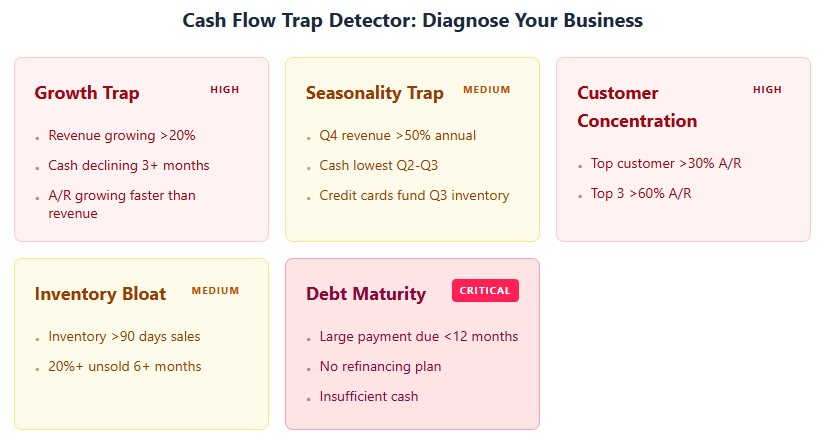
“Profit is not cash” is a familiar line, but by itself it does not tell an owner what to do. These are five common cash-flow traps, each with a trigger you can measure.
1. The growth trap
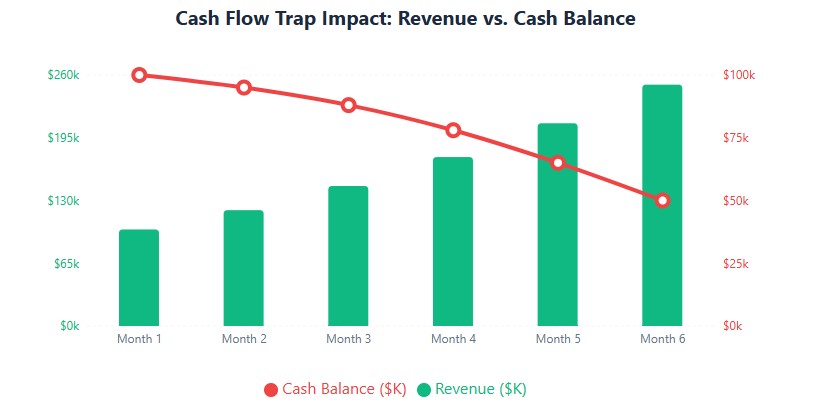
Trigger: receivables growing at more than 1.5x the rate of revenue (Ridgeline: 23% vs 9% = 2.6x) or DSO rising for two consecutive quarters; a profit-to-cash conversion below 0.8 supports the signal but does not prove it.
Size it before it happens: new cash needed ≈ added revenue × working capital intensity (16.25% for Ridgeline), plus equipment.
| Revenue growth | Added revenue | Added working capital needed |
|---|---|---|
| 10% | $480K | $78K |
| 20% | $960K | $156K |
| 30% | $1,440K | $234K |
| 40% | $1,920K | $312K |
Ridgeline has $320K of immediate liquidity: $180K in cash plus $140K of undrawn revolver capacity. Keep one month of fixed costs ($121.5K) untouched as a buffer, leaving $198.5K available. On the company’s 16.25% working-capital intensity, that supports about 25% growth—roughly $1.22M in added revenue—before the buffer is breached. This ignores profit from new sales and any equipment purchases. A 30% growth plan needs outside funding or a shorter cash cycle. Arrange a working capital loan or a larger credit line before growth begins; waiting until cash is tight puts the company in a weaker position with lenders.
2. The seasonality trap
Watch for a quarter that produces more than 40% of annual revenue while the lowest-cash month falls more than 60 days before the peak. Set aside enough to cover fixed costs during the trough, and arrange the credit line in the strong quarter. Lenders judge the balance sheet they see on the application date; for a seasonal business, that snapshot often looks best just after the peak.
3. The customer concentration trap
Concentration becomes a concern when one customer accounts for more than 20% of revenue or 30% of receivables, or when the top three customers exceed 50% of revenue. Ridgeline is already exposed: its largest customer contributes 24%, and its top three contribute 51%. Above a lender’s concentration threshold—often 25% to 30%, depending on the agreement—a receivable may be excluded from the borrowing base. Check the specific clause.
Consider a 30-day delay from Ridgeline’s largest customer, which represents $1,152K in annual sales, or about $3.16K a day. Receivables would rise by roughly $94.7K. If the company funds that gap from its revolver, undrawn credit falls from $140K to about $45K and liquidity runway drops from 2.6 months to 1.85. The scorecard would fall from 7 points to 4 on that measure. Deposits, shorter terms for large accounts, and trade credit insurance can reduce the exposure.
4. The inventory bloat trap
A rising DIO for three quarters in a row, or more than 15% of inventory sitting untouched for 12 months, deserves a closer look. Ridgeline is near both warning lines: DIO is 61 days and 13.5% of inventory has not moved in a year. A late write-down hurts twice: the cash was tied up already, and equity takes the hit all at once—often when a covenant test is least convenient.
5. The debt maturity trap
Flag debt when more than 25% falls due within 12 months or a balloon payment is larger than cash plus undrawn credit. Start refinancing discussions 12–18 months before maturity, while the last two years of financials still look solid. Ridgeline has $280K of current debt ($160K revolver + $120K current term debt), equal to 26% of its $1,060K funded debt, so it crosses the trigger.
Balance sheet by business model
A ratio that looks healthy in one industry may be normal—or worrying—in another. The ranges below are my planning estimates based on small-business financials, not statistics from a single dataset or a published methodology. Use them to decide what to investigate first, then benchmark against current industry data such as the US Census Bureau’s Quarterly Financial Report (balance-sheet and income-statement ratios by industry and asset size) and Aswath Damodaran’s industry datasets.
| Business model | DSO | DIO | DPO | Cash conversion cycle | Current ratio | What to watch |
|---|---|---|---|---|---|---|
| B2B services / agency | 40 to 60 | n/a | 15 to 30 | 10 to 45 | 1.3 to 2.0 | Unbilled work in progress; a few clients owing most of the A/R |
| Light manufacturing | 40 to 55 | 55 to 90 | 30 to 45 | 60 to 100 | 1.5 to 2.2 | Raw materials vs finished goods; obsolete stock |
| Wholesale distribution | 35 to 50 | 45 to 75 | 30 to 40 | 50 to 80 | 1.4 to 2.0 | Supplier rebates; inventory valuation method |
| Direct-to-consumer e-commerce | 2 to 7 | 60 to 120 | 20 to 45 | 40 to 90 | 1.2 to 2.0 | Inventory is the whole balance sheet; returns reserve |
| Restaurants | 1 to 3 | 5 to 12 | 15 to 30 | −25 to 0 | 0.3 to 0.9 | A low current ratio is normal; lease liabilities dominate |
| Contractors | 50 to 75 (incl. retainage) | 0 to 15 | 30 to 50 | 20 to 50 | 1.2 to 1.8 | Over/under-billings on jobs in progress; retainage receivable |
| SaaS (annual prepaid) | 30 to 60 (on invoiced amounts) | n/a | 20 to 40 | Often negative | 0.8 to 1.5 | Deferred revenue; capitalized software costs |
SaaS: deferred revenue is not liquidity
You may see advice to add deferred revenue to cash to get a “true liquidity” figure. That reverses the meaning of the line: deferred revenue is a liability because the company still owes customers the service. A rough first pass is cash minus the expected cash cost of delivering what remains. This is only a screening estimate, not a liquidity standard. Gross margin alone is a weak proxy because cost of revenue may exclude support, customer success, credits, refunds, and commissions already paid.
| Case: $900K cash, $600K deferred revenue | Cost to deliver | Cash left after delivery obligations |
|---|---|---|
| Gross-margin basis (80% margin) | $120K | $780K |
| Fully loaded service cost (40%, incl. support and success) | $240K | $660K |
| Contracts allow pro-rata refund on cancellation | up to $600K | as low as $300K |
A useful estimate needs four inputs: delivery costs by contract month, contract end dates, refund and termination terms, and cash already committed elsewhere. The deferred-revenue liability runs off as the service is delivered. Lenders financing recurring revenue usually focus first on ARR and churn, then on the balance sheet. Negative working capital can be normal for SaaS and is not automatically a covenant problem when the contract economics support it.
Contractors: over- and under-billings
Contractors using percentage-of-completion accounting recognize revenue as work progresses. When recognized revenue exceeds billings, the difference appears as an asset—often called underbillings or “costs and estimated earnings in excess of billings.” When billings exceed recognized revenue, the difference is a liability. Banks and sureties pay close attention to underbillings: a large balance can represent profit that has not yet been invoiced and may never be collected.
Balance sheet for an SBA 7(a) loan or bank covenant test
A lender rarely takes the balance sheet at face value. It rebuilds the picture using tax returns, receivables aging, and inventory listings, then tests the loan covenants against its own adjusted numbers. Lenders commonly verify tax-return information through IRS transcripts requested with Form 4506-C. If the balance sheet does not reconcile with the filed return, expect questions.
Case: Ridgeline applies for a $900K SBA 7(a) loan
Ridgeline is seeking $900K: $600K for a CNC machining center and $300K to refinance the revolver and add working capital. The lender’s analyst makes three adjustments to the December 31, 2025 balance sheet. Two reduce the balance-sheet total; the third changes classification only:
| Adjustment | Amount ($K) | Why the lender does it | Changes total assets? |
|---|---|---|---|
| Reclassify the affiliate receivable out of current assets | 45 | It is owed by an entity the owner controls, not by a customer | No: classification only; deducted from TNW by the covenant definition |
| Book an A/R allowance from the aging | 46 | $60K is over 90 days past due; the aging matrix gives $46K | Yes: assets and equity −46 |
| Book an inventory reserve from the aging | 57 | $70K has not moved in 12 months; the matrix gives $57K | Yes: assets and equity −57 |
Three balance sheets that each balance
Here is Ridgeline’s balance sheet as reported, as the lender sees it after adjustments, and after the company takes corrective action. Each column balances: total assets equal total liabilities plus equity.
| USD thousands | As reported | Lender view | After actions |
|---|---|---|---|
| Cash | 180 | 180 | 180 |
| Trade receivables, net of allowance | 545 (gross) | 499 | 499 |
| Inventory, net of reserve | 520 | 463 | 463 |
| Prepaids | 30 | 30 | 30 |
| Affiliate receivable | 45 (inside A/R: 590 total) | 45 (non-current) | 0 |
| Current assets | 1,320 | 1,172 | 1,172 |
| Property and equipment, net + goodwill | 1,080 | 1,080 | 1,080 |
| Total assets | 2,400 | 2,297 | 2,252 |
| A/P and accrued expenses | 420 | 420 | 420 |
| Revolver | 160 | 160 | 75 |
| Current portion of term debt | 120 | 120 | 120 |
| Current liabilities | 700 | 700 | 615 |
| Term debt, non-current | 780 | 780 | 780 |
| Total liabilities | 1,480 | 1,480 | 1,395 |
| Paid-in capital | 200 | 200 | 240 |
| Retained earnings | 720 | 617 | 617 |
| Total equity | 920 | 817 | 857 |
| Liabilities + equity | 2,400 | 2,297 | 2,252 |
| Tangible net worth (equity − goodwill − affiliate receivable) | 820 | 672 | 757 |
The journal entries behind the third column
| Step | Entry | Total assets after step | Effect |
|---|---|---|---|
| Start | Reported balance sheet | 2,400 | |
| 1. Book reserves | Dr bad-debt and inventory expense 103 / Cr allowance 46 and reserve 57 | 2,297 | Assets and equity −103 |
| 2. Reclassify affiliate balance | Dr affiliate receivable 45 / Cr trade A/R 45 | 2,297 | Classification only; TNW falls 45 under the covenant definition |
| 3. Collect the affiliate balance | Dr cash 45 / Cr affiliate receivable 45 | 2,297 | Asset changes form; the TNW deduction disappears |
| 4. Apply the cash to the revolver | Dr revolver 45 / Cr cash 45 | 2,252 | Assets and liabilities −45 |
| 5. Owner contributes cash | Dr cash 40 / Cr paid-in capital 40 | 2,292 | Assets and equity +40 |
| 6. Apply the contribution to the revolver | Dr revolver 40 / Cr cash 40 | 2,252 | Assets and liabilities −40 |
There are two points to take away. First, repaying debt with cash reduces both assets and liabilities, which is why total assets end at $2,252K rather than the $2,297K balance before the two repayments. Second, reclassification moves an amount between lines without changing the total, but the loan agreement may still change what counts toward tangible net worth. Collecting the affiliate balance in cash removes that deduction altogether.
| Measure ($K) | Typical covenant | As reported | Lender view | After actions |
|---|---|---|---|---|
| Current ratio | ≥ 1.25x | 1.89x | 1.67x | 1.91x |
| Quick ratio | ≥ 1.0x | 1.10x | 0.97x (fail) | 1.10x |
| Tangible net worth | positive; minimum set in agreement | 820 | 672 | 757 |
| Liabilities ÷ TNW | ≤ 2.0x | 1.80x | 2.20x (fail) | 1.84x |
| DSCR after distributions (pre-loan) | ≥ 1.25x | 1.61x | 1.61x | 1.61x |
Ridgeline passes every test using its own figures but fails two under the lender’s view. That is the issue in a nutshell: the reported balance sheet is not necessarily wrong; it may simply be missing reserves.
How much room the fixed balance sheet leaves
- Liabilities ÷ TNW: with liabilities of $1,395K, TNW must stay above $697.5K, so only $59.5K of additional write-downs or distributions funded from cash can be absorbed. A repeat of the $120K distribution is safe only if profit replaces it.
- Quick ratio: quick assets of $679K against current liabilities of $615K leave $64K of headroom before the 1.0x line.
- DSCR on the new loan: the pre-loan 1.61x flatters the case. Assume the $900K loan at 9.5% (a prime rate of 6.75% plus a 2.75-point spread; confirm against current prime) over 10 years: annual payments of about $140K. With the existing term debt service of about $156K (120 principal plus about 36 of interest; the revolver is refinanced), total debt service is about $296K. Holding 1.25x needs $370K of cash available for debt service. With $120K of distributions, EBITDA must rise from $390K to about $490K, a $100K lift from the new machine; with distributions cut to $60K, the lift needed is about $40K. Expect the lender to ask for both a machine-level productivity case and a distribution limit.
What is not acceptable
Reclassifying debt to a longer term than the contract allows; removing goodwill because it is “unverified” (goodwill is already excluded from TNW, so this changes nothing and reduces equity); presenting statements that differ from the tax return without a documented reconciliation.
Template: covenant definitions to request in the term sheet
“Tangible Net Worth” means total equity less intangible assets (including goodwill) less amounts due from affiliates, plus Subordinated Debt that is subject to a written subordination agreement acceptable to Lender.
“DSCR” means (net income + interest expense + depreciation and amortization + non-cash charges − distributions other than Tax Distributions) ÷ (scheduled principal + interest), tested annually on CPA-prepared statements.
GAAP is applied consistently with the financial statements dated {{DATE}}; a change in accounting standards (including lease accounting) does not affect covenant calculations unless the parties amend this agreement.
A covenant breach may be cured within 30 days by an equity contribution or Subordinated Debt in an amount sufficient to restore compliance.
The first and third clauses deserve the most attention. Subordinated owner debt may count toward tangible net worth, and a “frozen GAAP” clause can prevent new lease or revenue rules from changing covenant calculations halfway through a loan. These points are often negotiable before signing and much harder to revisit after a breach.
Tax return vs book balance sheet
- Schedule L on Forms 1120-S, 1065 and 1120 is a balance sheet that, per the IRS instructions, should agree with the company’s books. Book income is reconciled to taxable income on Schedule M-1 (M-3 for larger entities). Small entities below the receipts and asset thresholds stated in the Schedule B (or Schedule K) question on their form may be exempt from Schedules L and M-1; check your form.
- Depreciation gap: for tax years beginning in 2026 the Section 179 limit is $2.56 million with a phase-out starting at $4.09 million (Rev. Proc. 2025-32), and 100% bonus depreciation is permanent for qualifying property acquired after January 19, 2025 (see Form 4562). If Ridgeline buys a $130K machine and deducts it fully for tax, but books depreciate it over seven years straight-line ($18.6K a year), tax basis at year-end is $0 and book value is $111.4K. The difference is a Schedule M-1 item, and lenders will ask for it in writing.
- SBA 7(a) context: the SBA guarantees 85% of loans up to $150K and 75% above, up to a $5 million maximum per loan (see the SBA’s 7(a) loan page). Under SOP 50 10 8, effective June 1, 2025, lenders must take available collateral on loans above $50,000 and require at least 10% equity injection for start-ups and changes of ownership; a seller note counts toward that injection only on full standby for the life of the loan. Lenders also underwrite the owner’s personal balance sheet (SBA Form 413). Read the full requirements in our SBA 7(a) loan guide and compare equipment financing if the loan is for machinery only.
GAAP vs IFRS vs German HGB: how the same company looks on three balance sheets
Accounting standards affect more than the labels on a balance sheet; they can change the numbers lenders use. If you are buying, selling, or borrowing across borders, start with the differences below. This is a summary for private companies, so check the rules that apply to your situation.
| Item | US GAAP | IFRS | German HGB |
|---|---|---|---|
| Asset valuation | Cost; no upward revaluation of property and equipment | Cost or revaluation model (IAS 16), a choice per asset class | Cost is a ceiling (§ 253 HGB); unrealized gains are not recognized, unrealized losses are (prudence principle, § 252 HGB) |
| Goodwill | Private companies may elect straight-line amortization up to 10 years; otherwise impairment test | No amortization; annual impairment test (IAS 36) | Amortized over its useful life; 10 years if the life cannot be reliably estimated (§ 253 HGB) |
| Development costs | Generally expensed (software has its own rules) | Capitalized once IAS 38 criteria are met | Option to capitalize development costs, research expensed (§ 248 HGB) |
| Leases (lessee) | ASC 842: operating leases on the balance sheet, single straight-line expense | IFRS 16: nearly all leases on the balance sheet; depreciation plus interest | No equivalent to IFRS 16; operating leases generally stay off the balance sheet |
| Inventory write-downs | Lower of cost and net realizable value; reversal prohibited; LIFO allowed | Lower of cost and NRV; reversal required if value recovers; LIFO prohibited | Strict lower-of-cost-or-market; reversal required when the reason lapses; LIFO allowed |
| Provisions | Loss contingencies when probable (a higher bar than “more likely than not”) and estimable | IAS 37: probable (more likely than not), best estimate | Provisions for uncertain liabilities and onerous contracts (§ 249 HGB); provisions for other purposes are not allowed |
| Pension discount rate | High-quality bond rate at the balance sheet date | High-quality corporate bond rate at the balance sheet date | 10-year average market rate (§ 253 HGB), so the gap versus IFRS flips direction as interest rates move |
| Cash flow statement | Required | Required | Required only for capital-market-oriented companies and groups; most Mittelstand GmbHs do not produce one |
| Income statement format | Usually by function (cost of goods sold) | By function or nature | Often by nature of expense (§ 275 HGB): material and personnel costs, no cost-of-goods-sold line |
Four practical consequences
- Balance sheet order is reversed. § 266 HGB lists fixed assets (Anlagevermögen) before current assets (Umlaufvermögen), the opposite of the US presentation. Check the heading before you read a German statement.
- Hidden reserves exist in assets, not in liabilities. Land bought for €300K in 1998 and worth €1.1M today sits at €300K under the HGB cost principle: a €800K hidden reserve. Provisions created to hide profit are prohibited, so the common claim that German companies “over-accrue liabilities” is a myth; the conservatism comes from cost-based assets and from recognizing losses early and gains late.
- The tax link is one-directional. The tax balance sheet starts from the commercial (HGB) balance sheet unless tax law prescribes otherwise (§ 5 EStG). The reverse link, which forced tax-driven choices into the HGB accounts, was abolished by the BilMoG reform in 2009.
- Size class decides the disclosure. Since the 2024 amendment of § 267 HGB, a company is small if it does not exceed two of three limits: €7.5M total assets, €15M revenue, 50 employees; medium up to €25M, €50M and 250 employees. Micro-companies (§ 267a): €450K, €900K and 10 employees. A small GmbH may publish only a balance sheet, which limits what a buyer can see before diligence.
Worked example: an HGB-to-IFRS bridge for a German machine builder
Consider a US buyer evaluating a German Mittelstand machine builder that reports under HGB: equity €6.00M, bank debt €4.00M, cash €1.20M, and EBITDA €3.20M. The seller has a €3.00M pension provision under HGB; under IFRS, the defined benefit obligation would be €3.40M. The example assumes a combined corporate and trade tax rate of 30%. The buyer’s analyst makes the following adjustments to create an IFRS-style view:
| Equity bridge | €M |
|---|---|
| HGB equity | 6.00 |
| Capitalize development costs (IAS 38) | +0.80 |
| Deferred tax on development costs (30%) | −0.24 |
| Pension provision raised to IFRS obligation | −0.40 |
| Deferred tax asset on pension (30%) | +0.12 |
| Reverse inventory write-downs beyond NRV | +0.30 |
| Deferred tax on inventory (30%) | −0.09 |
| IFRS-style equity | 6.49 |
IFRS 16 also increases both assets and liabilities on the balance sheet. Assume €1.50M in right-of-use assets and an equal lease liability, with no effect on equity at inception. The bigger issue is leverage: the same company produces three different net-debt ratios depending on the definition used.
| Definition | Net debt (€M) | EBITDA (€M) | Net debt ÷ EBITDA |
|---|---|---|---|
| HGB: bank debt less cash | 2.80 (4.00 − 1.20) | 3.20 | 0.88x |
| IFRS 16 basis: add €1.50M lease liability; add back ≈ €0.35M annual rent to EBITDA | 4.30 | 3.55 | 1.21x |
| Buyer’s debt-like view: also add the €3.40M pension obligation (pre-tax) | 7.70 | 3.55 | 2.17x |
A buyer using the HGB ratio sees 0.88x; a buyer who counts pensions and leases as debt sees 2.17x. Agree on the definition before negotiating the price, and use the EBITDA figure that matches it. Applying a multiple based on pre-IFRS 16 EBITDA to post-IFRS 16 EBITDA can double-count the lease. Capitalized development costs also lift IFRS EBITDA in the year they arise, though that effect is not included here. For a German target’s DPO and gross margin, use material expense as a proxy for cost of goods sold because a nature-of-expense income statement has no separate COGS line.
US companies: IFRS 16 vs ASC 842 on a single lease
Take a five-year office lease at $8,000 a month with a 7% discount rate. At inception, the lease liability is about $404K (8,000 × 50.50, the present-value factor for 60 monthly payments at 0.583% a month). On a balance sheet like Ridgeline’s, total liabilities ÷ equity rises from 1.61x to 2.05x ((1,480 + 404) ÷ 920) under either standard. Under ASC 842, rent remains a straight-line operating expense of $96K a year, so EBITDA does not change. Under IFRS 16, the expense is split into depreciation (about $81K a year) and interest (about $25K in year one, declining over time), lifting EBITDA by the full $96K. Same lease, different EBITDA. That is why the covenant definition needs to specify the accounting standard. Private US companies adopted ASC 842 for fiscal years beginning after December 15, 2021, so the old advice that operating leases stay off US GAAP balance sheets is out of date.
30-day sequence for Ridgeline
| Week | Action | Output | Ridgeline cash effect |
|---|---|---|---|
| 1 | Rebuild the balance sheet on accrual basis; run A/R and inventory aging; book reserves | Corrected statements; reserve policy note | None (equity −$103K, assets −$103K) |
| 2 | Send the three-step collections sequence to all accounts past due; collect the $45K affiliate balance | Cash application list | +$45K from the affiliate; at a 70% collection rate, +$63K of the $90K over 60 days |
| 3 | Liquidate the over-365-day inventory at an expected 40% of cost; send the supplier terms request to the top three vendors | Sell-through list; supplier replies | +$28K from stock; +$51K if DPO rises by 6 days |
| 4 | Apply cash to the revolver; recompute the scorecard and covenant table on the new balance sheet | Updated scorecard and lender package | $187K total released, equal to the sum of the lines above (45 + 63 + 28 + 51) |
Last updated: October 2026