Executive Summary
Business Name: Midnight Mane Studio
Location: Urban neighborhood, 1,000 sq ft retail space
Concept: Tiered-service salon specializing in texture-specific styling (curly/coily hair), sustainable retail products, and time-guaranteed appointments for busy professionals
Legal Structure: Single-Member LLC
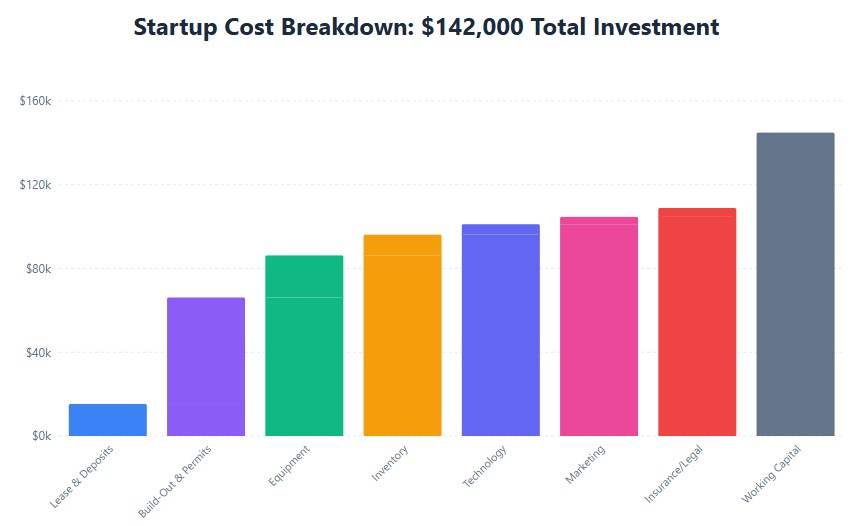
Startup Cost: $142,000
Funding Request: $95,000 SBA 7(a) loan + $47,000 owner equity
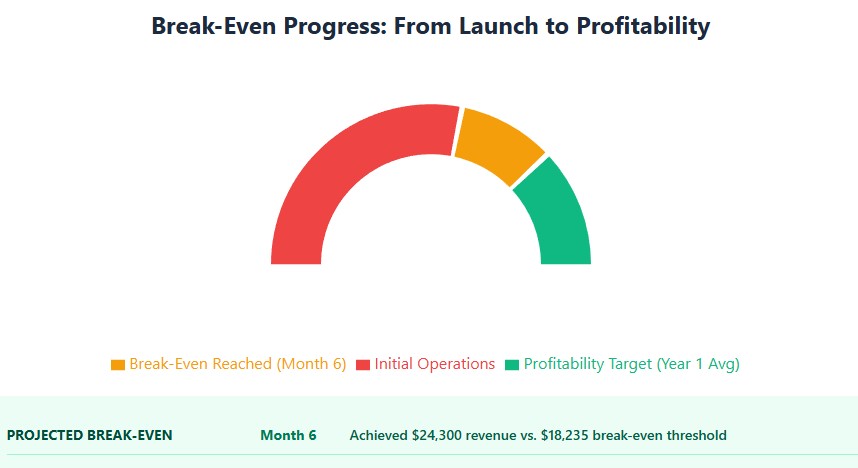
Break-Even: Month 6 (based on 75% chair utilization at $85 average ticket)
Projected Year 1 Revenue: $320,252
Projected Year 3 Revenue: $441,450
The Problem We Solve
Urban professionals face three recurring frustrations with traditional salons:
- Unpredictable wait times: Even with appointments, 30+ minute delays are common
- Lack of texture expertise: Clients with curly, coily, or thick hair report inconsistent results and stylists without proper training
- Transactional relationships: Pushy retail sales and one-size-fits-all service menus that don’t reflect individual needs
Our Solution
Midnight Mane Studio differentiates through:
- Time guarantees: Appointments start on time or the service is 20% off
- Texture specialization: All stylists certified in curly/coily hair cutting techniques (DevaCut, Ouidad, Rezo)
- Tiered service design: Clear packages (Foundation, Signature, Texture Specialist) that reduce decision fatigue
- Integrated retail: Products prescribed during service, not pushed at checkout
Financial Highlights
| Metric | Year 1 | Year 2 | Year 3 |
|---|---|---|---|
| Total Revenue | $320,252 | $419,450 | $514,200 |
| Net Income | $30,189 | $61,798 | $95,420 |
| Net Margin | 9.4% | 14.7% | 18.6% |
| Cumulative Cash Flow | $20,850 | $82,648 | $169,372 |
Market Analysis
Target Market Definition
Forget “women 25–45.” Real targeting starts with hyper-local data and behavioral segmentation.
Primary Trade Area: 1-mile radius around proposed location
Population: ~18,500 residents
Median Household Income: $78,400 (U.S. Census ACS 2024)
Daily Foot Traffic: ~3,200 pedestrians (based on urban neighborhood averages)
Client Segments
We’ve identified three distinct client personas through local market research:
| Segment | Size (Est.) | Pain Points | Our Solution | Annual Value |
|---|---|---|---|---|
| Time-Poor Professional | 4,200 | Can’t afford wait times, values efficiency, books last-minute | Guaranteed start times, silent-chair zones, seamless online booking | $680 |
| Texture Advocate | 2,800 | Curly/coily hair, frustrated by stylists without training, inconsistent results | Certified texture specialists, customized techniques, education-focused | $920 |
| Sustainable Beauty Seeker | 3,100 | Avoids animal testing, plastic waste, wants transparent sourcing | Clean product lines, refillable options, carbon-neutral operations | $740 |
Competitive Analysis
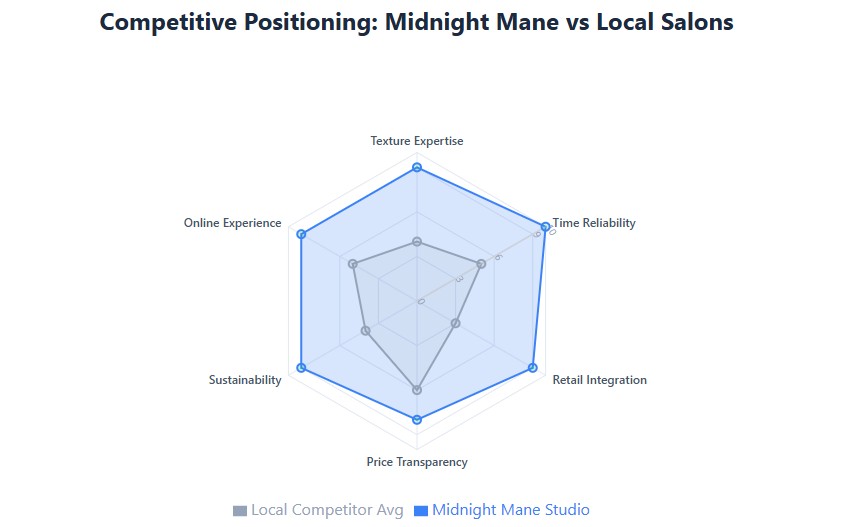
Direct Competitors (0.5-mile radius): 7 salons
Indirect Competitors: 3 blow-dry bars, 2 barber shops, 5 home-based stylists
| Competitor | Distance | Price Range | Strengths | Weaknesses | Our Advantage |
|---|---|---|---|---|---|
| Salon A (Full-service) | 0.2 mi | $45–$120 | Established, loyal base | No texture specialization, frequent delays | Time guarantees, certified curl experts |
| Salon B (Boutique) | 0.3 mi | $65–$150 | High-end experience | Limited availability, no online booking | Seamless booking, transparent pricing |
| Salon C (Budget) | 0.4 mi | $25–$60 | Affordable | High turnover, inconsistent quality | Trained stylists, retention programs |
Gap Analysis: Only 2 of 7 competitors offer any curly hair specialization. None guarantee appointment start times. None have integrated sustainability programs.
Services & Pricing Strategy
The 3-Pillar Revenue Framework
Most salons rely on one income stream: chair time. Midnight Mane uses three that reinforce each other:
Pillar 1: Tiered Service Design
Not just junior vs. senior pricing. Clear packages with defined outcomes that reduce decision fatigue and price haggling.
| Service Tier | Price Range | What’s Included | Target Margin | Positioning |
|---|---|---|---|---|
| Foundation | $55–$75 | Consultation, cut, blow-dry, basic product sample | 65–70% | Entry point for new clients |
| Signature | $95–$135 | Everything in Foundation + scalp treatment, personalized regimen, follow-up text | 72–78% | Most popular (40% of revenue) |
| Texture Specialist | $110–$165 | Curly/coily expertise, customized cut technique (DevaCut/Ouidad), take-home care guide | 70–75% | Premium differentiation |
Why it works: Clients self-select based on needs, not price haggling. The Signature tier drives 40% of revenue at 25% of volume.
Pillar 2: Retail Integrated Into Service
Instead of pushing products at checkout, stylists “prescribe” regimens during the appointment:
- Stylist applies product during service and explains its purpose
- Clients receive a printed regimen card with product names and usage instructions
- Reorder reminders sent via SMS at 80% product depletion (based on usage estimates)
Real benchmark: Salons using this model see 35–50% retail attach rate vs. industry average of 12–18% (Professional Beauty Association, 2025).
| Product Category | Avg Retail Price | Wholesale Cost | Gross Profit | Margin % | Attach Rate Target |
|---|---|---|---|---|---|
| Shampoo / Conditioner | $28 | $14 | $14 | 50% | 35% |
| Styling Products | $24 | $12 | $12 | 50% | 40% |
| Treatment Masks | $32 | $16 | $16 | 50% | 25% |
| Heat Protectant | $26 | $13 | $13 | 50% | 30% |
| Tools (Brushes, etc.) | $35 | $17.50 | $17.50 | 50% | 15% |
Pillar 3: Monetize Expertise Beyond the Chair
Revenue during downtime, deeper client relationships:
- Express Consultations: $25 for 15-minute color transition planning or product troubleshooting (booked between appointments)
- Virtual Check-Ins: $15 for 10-minute video review of at-home styling (reduces corrective appointments)
- Quarterly Workshops: $45/person for curly-hair care classes (max 8 attendees)
Projected contribution: 10–15% of total revenue at 85%+ margin (low overhead, high perceived value).
Detailed Service Pricing Matrix
| Service | Price | Time | Product Cost | Stylist Commission | Gross Profit | Margin % |
|---|---|---|---|---|---|---|
| Foundation Cut | $55 | 45 min | $2.50 | $24.75 (45%) | $27.75 | 50.5% |
| Signature Cut + Style | $75 | 60 min | $4.00 | $33.75 (45%) | $37.25 | 49.7% |
| Full Color (Single Process) | $95 | 90 min | $12.00 | $42.75 (45%) | $40.25 | 42.4% |
| Partial Highlights | $135 | 120 min | $18.00 | $60.75 (45%) | $56.25 | 41.7% |
| Full Highlights + Tone | $185 | 150 min | $25.00 | $83.25 (45%) | $76.75 | 41.5% |
| Curly Hair Specialist Cut | $110 | 75 min | $3.50 | $49.50 (45%) | $57.00 | 51.8% |
| Balayage | $225 | 180 min | $32.00 | $101.25 (45%) | $91.75 | 40.8% |
| Blowout / Styling | $45 | 45 min | $3.00 | $20.25 (45%) | $21.75 | 48.3% |
| Deep Conditioning Treatment | $35 | 30 min | $5.00 | $15.75 (45%) | $14.25 | 40.7% |
| Scalp Treatment Add-On | $25 | 15 min | $2.00 | $11.25 (45%) | $11.75 | 47.0% |
Startup Costs & Funding
Detailed Startup Budget
Based on urban salon builds in secondary markets (not NYC/SF). All figures verified against 2025–2026 vendor quotes.
| Category | Item | Cost | Timing |
|---|---|---|---|
| Lease & Deposits | Security Deposit (2 months) + First + Last | $12,800 | Month 0 |
| Leasehold Improvements Deposit | $2,500 | Month 0 | |
| Total Lease Costs | $15,300 | ||
| Build-Out & Permits | General Contractor (plumbing, electrical, HVAC) | $42,000 | Months 1–2 |
| City Permits & Inspections | $2,400 | Month 1 | |
| Salon License & State Board Inspection | $850 | Month 2 | |
| Signage (exterior + interior) | $2,400 | Month 2 | |
| Paint & Finishing | $3,200 | Month 2 | |
| Total Build-Out | $50,850 | ||
| Equipment & Furniture | Styling Stations (4 units) | $6,400 | Month 2 |
| Hydraulic Styling Chairs (4) | $3,200 | Month 2 | |
| Shampoo Bowls & Chairs (2) | $2,800 | Month 2 | |
| Hair Dryers, Tools, Backbar | $2,400 | Month 2 | |
| Reception, Retail Displays, Waiting Area | $4,500 | Month 2 | |
| Towels, Capes, Linens (initial) | $800 | Month 2 | |
| Total Equipment | $20,100 | ||
| Initial Inventory | Professional Color Line | $3,200 | Month 2 |
| Retail Products (initial stock) | $4,500 | Month 2 | |
| Styling Products, Disposables, Sanitation | $2,200 | Month 2 | |
| Total Inventory | $9,900 | ||
| Technology & Software | POS System (hardware) | $1,200 | Month 2 |
| Booking Software (annual) | $600 | Month 2 | |
| Website Design & Hosting (annual) | $1,100 | Month 1 | |
| Security System, Computers, Phone | $2,100 | Month 2 | |
| Total Technology | $5,000 | ||
| Marketing Launch | Branding & Logo Design | $800 | Month 1 |
| Grand Opening Event | $1,500 | Month 3 | |
| Initial Digital Ads (3 months) | $1,200 | Months 1–3 | |
| Total Marketing | $3,500 | ||
| Insurance & Legal | General + Professional Liability (annual) | $1,800 | Month 0 |
| Workers’ Compensation (deposit) | $800 | Month 2 | |
| Business License, LLC Formation, Legal Review | $1,650 | Month 0 | |
| Total Insurance & Legal | $4,250 | ||
| Working Capital | Payroll Reserve (3 months) | $18,000 | Months 1–3 |
| Operating Expenses Reserve (3 months) | $6,000 | Months 1–3 | |
| Contingency Fund (10%) | $12,000 | As needed | |
| Total Working Capital | $36,000 | ||
| TOTAL STARTUP COST | $142,000 | ||
Funding Sources
| Source | Amount | Type | Terms | Use of Funds |
|---|---|---|---|---|
| SBA 7(a) Loan | $95,000 | Debt | 11% interest, 10-year term, monthly payment $1,199 | Build-out ($50,850), Equipment ($20,100), Working capital ($24,050) |
| Owner Equity | $47,000 | Equity | No repayment required | Lease deposits ($15,300), Inventory ($9,900), Technology ($5,000), Marketing ($3,500), Insurance/Legal ($4,250), Contingency ($9,050) |
| TOTAL FUNDING | $142,000 | |||
Financial Projections
Revenue Model & Assumptions
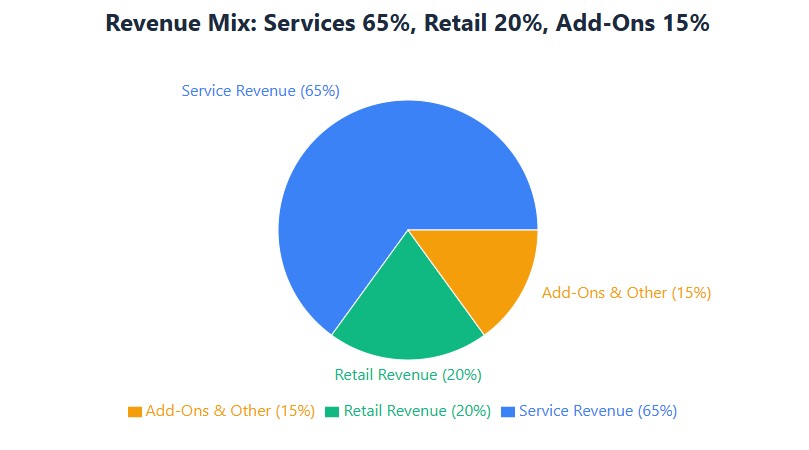
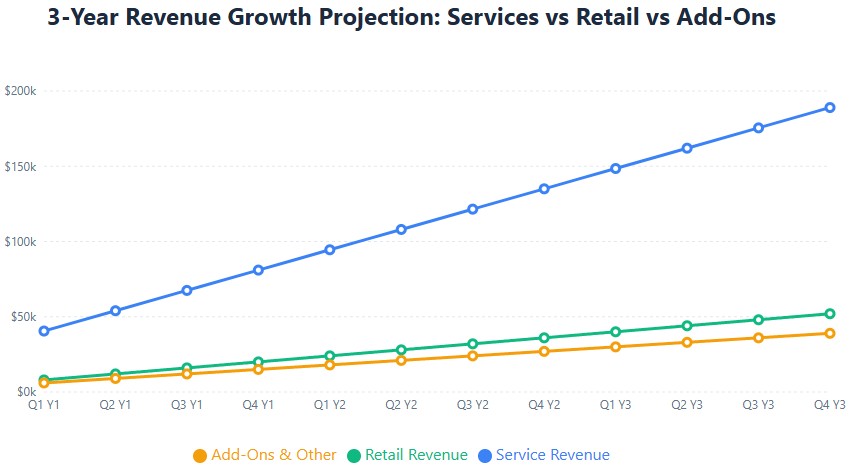
Service Mix: 65% services, 20% retail, 15% add-ons (consultations, workshops, treatments)
Pricing Strategy: Tiered packages (Foundation $55–$75, Signature $95–$135, Texture Specialist $110–$165)
Capacity: 4 styling stations, 16 appointment slots/day (4 stations × 4 slots)
Utilization Ramp: Month 1–3: 50%, Month 4–6: 65%, Month 7–9: 75%, Month 10–12: 80%
Average Ticket: $85 (weighted average of service tiers + retail + add-ons)
Operating Days: 240/year (6 days/week, minus holidays)
3-Year Financial Summary
| Metric | Year 1 | Year 2 | Year 3 | 3-Year Total |
|---|---|---|---|---|
| Revenue: | ||||
| Service Revenue | $208,164 | $272,643 | $334,230 | $815,037 |
| Retail Revenue | $64,050 | $83,890 | $102,840 | $250,780 |
| Other Revenue (consultations, workshops) | $48,038 | $62,917 | $77,130 | $188,085 |
| Total Revenue | $320,252 | $419,450 | $514,200 | $1,253,902 |
| Cost of Goods Sold: | ||||
| Product Costs (retail + backbar) | $64,050 | $83,890 | $102,840 | $250,780 |
| Stylist Commissions (45–50%) | $93,674 | $122,494 | $150,404 | $366,572 |
| Total COGS | $157,724 | $206,384 | $253,244 | $617,352 |
| Gross Profit | $162,528 | $213,066 | $260,956 | $636,550 |
| Gross Margin % | 50.7% | 50.8% | 50.8% | 50.8% |
| Operating Expenses: | ||||
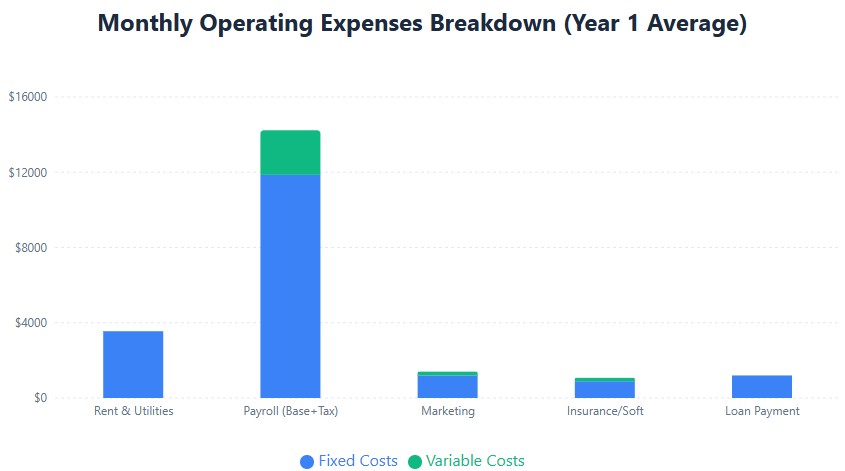
| Rent & Utilities | $42,600 | $43,878 | $45,194 | $131,672 |
| Payroll (base salaries, payroll taxes) | $142,320 | $177,040 | $211,600 | $530,960 |
| Marketing & Advertising | $14,400 | $9,600 | $12,000 | $36,000 |
| Insurance, Software, Maintenance | $10,704 | $11,232 | $11,784 | $33,720 |
| Loan Payment (principal + interest) | $14,388 | $14,388 | $14,388 | $43,164 |
| Total Operating Expenses | $224,412 | $256,138 | $294,966 | $775,516 |
| Net Income (Before Tax) | $30,189 | $61,798 | $95,420 | $187,407 |
| Net Margin % | 9.4% | 14.7% | 18.6% | 15.0% |
Monthly Break-Even Analysis
| Metric | Value | Calculation |
|---|---|---|
| Fixed Costs (Monthly) | $12,400 | Rent + Utilities + Insurance + Software + Base Salaries |
| Variable Cost % | 32% | COGS + Commissions + Processing Fees as % of Revenue |
| Contribution Margin | 68% | 100% – 32% Variable Costs |
| Average Ticket Price | $85 | Weighted average of all services + retail |
| Break-Even Revenue | $18,235/month | Fixed Costs ÷ Contribution Margin = $12,400 ÷ 0.68 |
| Break-Even Appointments/Day | 10.7 | $18,235 ÷ $85 ÷ 20 working days |
| Break-Even Chair Utilization | 67% | 10.7 appointments ÷ 16 max daily slots (4 stations × 4 slots) |
| PROJECTED BREAK-EVEN | Month 6 | Achieved $24,300 revenue vs. $18,235 break-even threshold |
Operations Plan
Staffing Model
Commission-only creates turnover. Booth rental kills collaboration. This hybrid model aligns incentives at every career stage.
| Role | Compensation Structure | Key Metrics | Year 1 Cost | Why It Works |
|---|---|---|---|---|
| Owner/Operator | $0 draw Year 1, then $1,000/month | Overall profitability, client satisfaction | $0 | Reinvest profits in Year 1 to build reserves |
| Senior Stylist #1 (Full-time, hired Month 1) |
No base + 50% service commission + 15% retail commission + $200/mo bonus for 4.8+ rating | Avg ticket size, pre-book rate, referral count | $42,000 | High upside for proven performers; incentivizes quality over volume |
| Senior Stylist #2 (Full-time, hired Month 3) |
Same as Senior #1 | Same as Senior #1 | $38,000 | Phased hiring matches revenue growth |
| Associate Stylist (Full-time, hired Month 6) |
$18/hr base + 35% service commission + 10% retail commission | Client retention rate, retail attach rate, on-time starts | $28,000 | Stability during client-building phase; rewards full-service thinking |
| Receptionist (Part-time 20 hrs/wk, hired Month 4) |
$15/hr + 2% retail team bonus | Booking accuracy, client satisfaction scores | $15,600 | Improves client experience, frees stylists to focus on service |
| Payroll Taxes & Benefits | 15% employer portion + workers’ comp | $18,720 | Compliance and retention | |
| TOTAL STAFFING COST | $142,320 | |||
| As % of Revenue | 44.5% | Industry benchmark: 40–50% | ||
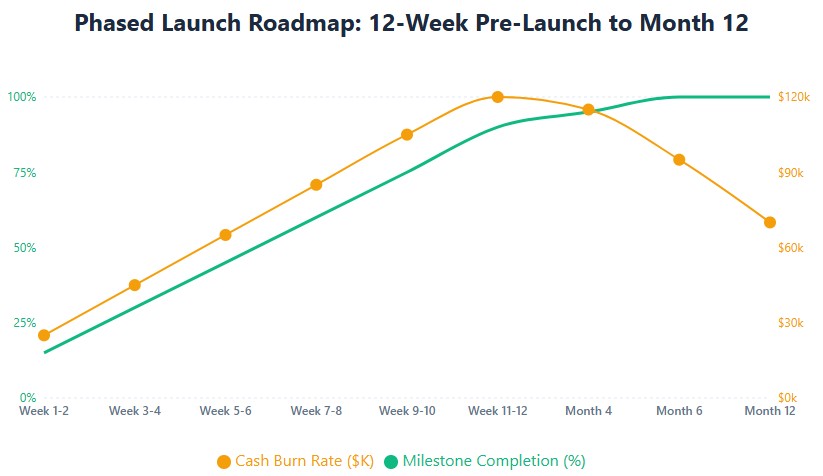
Phased Launch Plan
Most salon budgets assume everything goes perfectly. Reality hits hard. This phased model treats the first 90 days as a paid beta.
Phase 1: Core Build (Months 1–2, 60% of Capital)
- Secure lease, complete essential build-out (plumbing, electrical, HVAC)
- Purchase core equipment: styling stations, shampoo bowls, POS system
- Hire and train founding team (2 senior stylists, 1 receptionist PT)
- Include 25% buffer for urban surprises: permit delays, code upgrades, extended rent overlap
- Budget: $85,200
Phase 2: Soft Launch (Month 3, 20% of Capital)
- Open with limited capacity: 50% of available appointments
- Invite-only client list: friends, family, local influencers, pre-booked consultations
- Test workflows: booking, service timing, retail integration, payment flow
- Goal: Reach 75% booking density with 4.5+ average review rating
- Budget: $28,400
Phase 3: Full Launch (Months 4–6, Remaining 20%)
- Activate full marketing: local SEO, Google Business Profile, community partnerships
- Hire associate stylist (Month 6), expand retail display, add express consultation slots
- Launch loyalty program and referral system
- Only proceed if Phase 2 goals are met—otherwise, iterate before scaling
- Budget: $28,400
Real-world buffer use: In a comparable urban launch, the 25% contingency covered a 6-week permit delay ($4,200 in extended rent) and unexpected electrical upgrades ($2,800). Without the buffer, cash flow would have turned negative in Month 2.
Marketing & Customer Acquisition
Brand Positioning
Tagline: “Your Hair, Your Time, Your Way”
Brand Personality: Professional, inclusive, efficient, sustainable
Visual Identity: Clean, modern, warm tones (citrus and sandalwood signature scent throughout space)
Customer Acquisition Strategy
| Channel | Target Audience | Monthly Budget | Expected CAC | Goal |
|---|---|---|---|---|
| Google Business Profile + Local SEO | “curly hair salon near me,” “best salon [neighborhood]” | $0 (organic) | $0 | Top 3 local pack ranking within 6 months |
| Google Ads (Search) | High-intent searches: “book haircut,” “same-day salon” | $400 | $35 | 15 new clients/month |
| Meta Ads (Instagram/Facebook) | Lookalike audiences, retargeting website visitors | $300 | $42 | 10 new clients/month |
| Community Partnerships | Local gyms, coffee shops, co-working spaces | $200 (event sponsorships) | $28 | 8 new clients/month |
| Influencer Collaborations | Micro-influencers (5K–20K followers) in neighborhood | $300 (complimentary services) | $38 | 6 new clients/month |
| Referral Program | Existing clients | $150 (referral credits) | $22 | 12 new clients/month |
| TOTAL MONTHLY MARKETING | $1,350 | Avg CAC: $33 | 51 new clients/month | |
Loyalty & Retention Program
Punch cards don’t build loyalty. They train clients to wait for freebies. Real retention comes from rewarding behaviors that strengthen the relationship: pre-booking, product use, and referrals.
| Program Tier | How to Earn | Core Benefit | Why It Works |
|---|---|---|---|
| Member | After 3 visits | Guaranteed booking window (48-hr hold), off-peak access (10% discount Tue–Thu) | Reduces no-shows, increases predictability |
| Inner Circle | 2 pre-booked visits + 1 retail purchase in 90 days | 5% product credit, guest pass (bring a friend at 20% off) | Boosts retail and referrals; turns clients into advocates |
| Founder’s Circle | By referral only (must be referred by Founder’s member) | Emergency same-day slots, trend preview events, birthday service | Creates exclusivity and emotional investment; viral growth |
Risk Assessment & Mitigation
| Risk | Likelihood | Impact | Probability × Impact | Mitigation Strategy | Owner |
|---|---|---|---|---|---|
| Key stylist departs with clients | Medium (40%) | High ($40K revenue loss) | 16 | Cross-train team; build brand loyalty (not stylist loyalty); non-solicit agreements where enforceable; document all client relationships in CRM | Owner |
| Permit delays extend build-out | High (70%, urban) | Medium ($7K extended rent) | 21 | 25% contingency buffer ($12K); phased launch model; temporary pop-up partnerships with local businesses | Owner + GC |
| Local competitor opens nearby | Medium (35%) | Medium ($25K revenue impact) | 12 | Double down on differentiation: texture specialization, time guarantees, sustainable retail; exclusive vendor partnerships | Owner + Marketing |
| Economic downturn reduces discretionary spend | Low–Medium (25%) | High ($60K revenue decline) | 15 | Maintain 3-month working capital reserve; offer “maintenance” tier at lower price point; focus on essential services (cuts vs. color) | Owner |
| Supply chain disruption (product shortage) | Low (15%) | Medium ($8K revenue impact) | 5 | Diversify suppliers (3+ vendors); maintain 6-week inventory buffer for core products; communicate alternatives to clients | Receptionist |
| Regulatory changes (licensing, labor laws) | Low (10%) | Low ($3K compliance cost) | 3 | Join state cosmetology association for updates; annual legal review; maintain compliance calendar | Owner + Attorney |
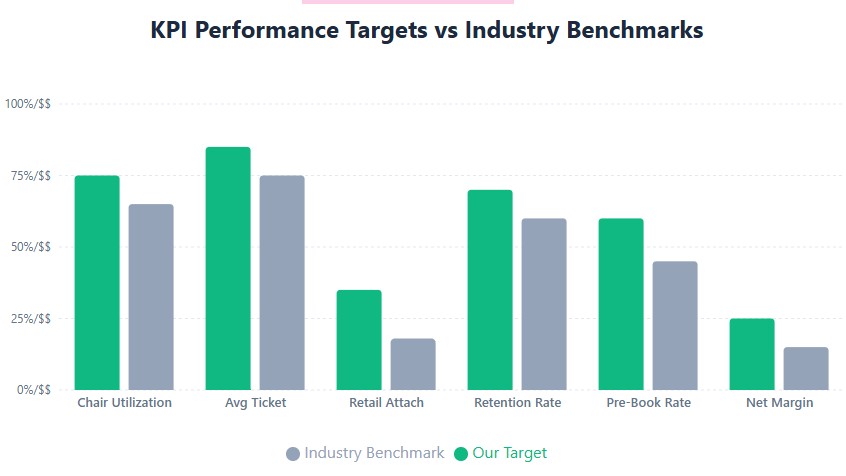
Key Performance Indicators (KPIs)
Track these metrics monthly to ensure the business stays on track:
| KPI | Target | Industry Benchmark | Calculation | Frequency | Owner |
|---|---|---|---|---|---|
| Chair Utilization Rate | ≥75% | 65–75% | Actual appointments ÷ Available slots | Weekly | Receptionist |
| Average Ticket Size | ≥$85 | $65–$85 | Total revenue ÷ Total appointments | Weekly | Owner |
| Retail Attach Rate | ≥35% | 12–20% | Clients purchasing retail ÷ Total clients | Weekly | Receptionist |
| Client Retention Rate | ≥70% | 55–65% | Returning clients ÷ Total clients | Monthly | Owner |
| Pre-Book Rate | ≥60% | 40–50% | Appointments pre-booked ÷ Total appointments | Weekly | Receptionist |
| Revenue per Square Foot | ≥$320 | $200–$300 | Total revenue ÷ Salon square footage | Quarterly | Owner |
| Payroll as % of Revenue | ≤45% | 40–50% | Total payroll costs ÷ Total revenue | Monthly | Owner |
| Net Profit Margin | ≥25% | 12–18% | Net income ÷ Total revenue | Monthly | Owner |
| Client Acquisition Cost (CAC) | ≤$45 | $50–$80 | Marketing spend ÷ New clients acquired | Monthly | Owner |
| Lifetime Value (LTV) | ≥$1,200 | $800–$1,000 | Avg ticket × Visits/year × Retention years | Quarterly | Owner |
| LTV:CAC Ratio | ≥3:1 | 2:1 | Lifetime Value ÷ Client Acquisition Cost | Quarterly | Owner |
Implementation Timeline
Pre-Launch (Months 1–3)
| Week | Task | Owner | Budget | Status |
|---|---|---|---|---|
| Week 1–2 | Finalize lease agreement, obtain EIN, register LLC | Owner | $400 | |
| Week 3–4 | Hire general contractor, submit permit applications | Owner | $2,400 | |
| Week 5–6 | Order equipment, finalize vendor contracts (color, retail) | Owner | $20,100 | |
| Week 7–8 | Begin build-out, hire senior stylists, set up booking software | Owner + GC | $22,500 | |
| Week 9–10 | Complete build-out, install equipment, hire receptionist | GC + Owner | $25,000 | |
| Week 11–12 | Staff training, soft launch (invite-only), collect feedback | All staff | $2,000 |
Post-Launch (Months 4–12)
| Milestone | Target Date | Success Metric | Contingency |
|---|---|---|---|
| Full launch (grand opening event) | Month 4 | 75% booking density, 4.5+ rating | If <60% density, extend soft launch 2 weeks |
| Hire associate stylist | Month 6 | 80% chair utilization, $20K+ monthly revenue | If <70% utilization, delay hire to Month 8 |
| Break-even | Month 6 | $18,235 monthly revenue | If not achieved, reduce marketing spend, add promotions |
| Launch loyalty program | Month 5 | 30% enrollment rate | If <15% enrollment, add sign-up bonus |
| Positive cash flow | Month 7 | Ending cash > opening cash | Maintain $36K reserve; adjust expenses if needed |
Exit Strategy & Long-Term Vision
3-Year Milestones
- Year 1: Establish brand, achieve profitability, build 500+ active client base
- Year 2: Expand to 5 stylists, add second location feasibility study, launch product line
- Year 3: Open second location or acquire existing salon, achieve $500K+ revenue, 20% net margin
Potential Exit Paths
| Exit Option | Timeline | Estimated Value | Requirements |
|---|---|---|---|
| Sell to competitor or consolidator | 5–7 years | 2.5–3.5× EBITDA ($300K–$500K) | Consistent profitability, strong client retention, documented systems |
| Sell to key employee(s) | 7–10 years | 2× EBITDA + inventory ($250K–$400K) | Train successor, owner financing arrangement, gradual transition |
| Franchise or license model | 5+ years | Franchise fees + royalties | Proven systems, brand recognition, operations manual, legal framework |
| Continue operating (lifestyle business) | Indefinite | Ongoing cash flow ($80K–$150K/year owner draw) | Maintain client base, adapt to trends, work-life balance |
Appendices
Appendix A: Monthly Cash Flow Tracker Template
Month: _________
Opening Cash: $_______

INCOMING
- Service Revenue: $_______
- Retail Sales: $_______
- Other (consultations, workshops): $_______
Total Inflow: $_______

OUTGOING
- Stylist Commissions: $_______
- Rent: $_______
- Utilities/Insurance: $_______
- Product Reorder: $_______
- Marketing: $_______
- Loan Payment: $_______
Total Outflow: $_______

Net Cash Flow: $_______
Ending Cash Balance: $_______
Reserve Target (3 months OpEx): $_______
Above/Below Target: $_______
Appendix B: Client Feedback Survey
Send within 24 hours of appointment:
1. How did we do today? (1–5 scale)
2. What's one thing we could improve?
3. Would you refer a friend? (Yes/No + why)
4. What service or product would make your next visit even better?
5. How likely are you to book again? (1–10)
Review responses weekly. Adjust training, menu, or experience based on patterns—not outliers.
Appendix C: Key Contacts
- SBA District Office: [Local office contact for loan assistance]
- CPA/Accountant: [Name, phone, email for tax planning]
- Business Attorney: [Name, phone, email for legal review]
- Insurance Agent: [Name, phone, email for coverage]
- Bank Relationship Manager: [Name, phone, email for business banking]
Next Steps
- Customize this plan: Replace Midnight Mane’s numbers with your market research, local rent quotes, and realistic revenue projections.
- Validate assumptions: Talk to 10+ potential clients in your target area. Confirm pricing tolerance, service preferences, and unmet needs.
- Consult professionals: Meet with an SBA-approved lender to discuss loan requirements. Engage a CPA to review tax structure and projections.
- Secure funding: Submit SBA 7(a) application with this business plan, personal financial statement, and 2 years of personal tax returns.
- Execute launch: Follow the phased implementation timeline. Track KPIs weekly. Adjust based on real data, not assumptions.
- Review quarterly: Compare actual results to projections. Update the plan annually or when major assumptions change.
Final Note
This business plan is a living document—not a one-time exercise. The salons that thrive aren’t the ones with perfect plans. They’re the ones that learn faster than their competitors, adapt to client needs, and execute consistently.
Use this template as your foundation. Add your unique value proposition. Build something that lasts.