The Three Bakery Models: Which One Are You Building?
Before we talk costs, you need to pick your lane. Each model has different capital requirements, regulatory hurdles, and revenue potential.
| Model | Best For | Startup Cost Range | Time to Launch | Revenue Potential (Year 1) |
|---|---|---|---|---|
| 1. Home-Based / Cottage Bakery | Solopreneurs testing concepts, farmers market vendors, online sellers | $8,000 – $35,000 | 4-8 weeks | $40,000 – $120,000 |
| 2. Wholesale Production Bakery | B2B suppliers to cafes, restaurants, grocers; no retail storefront | $150,000 – $350,000 | 3-5 months | $250,000 – $600,000 |
| 3. Retail Bakery & Cafe | Full storefront with seating, coffee service, on-site production | $275,000 – $550,000 | 6-12 months | $400,000 – $1.2M |
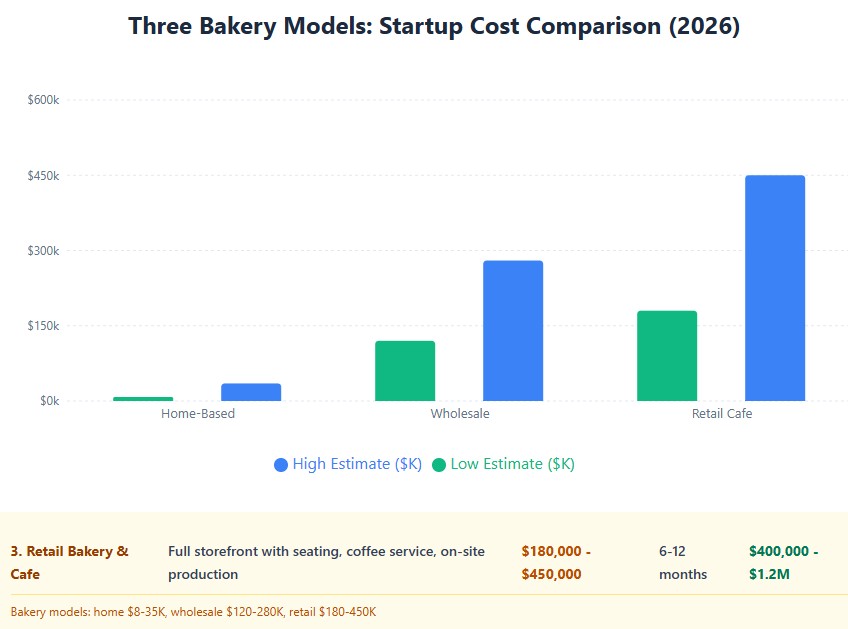
Key insight: Most first-time bakery owners underestimate Model 3 by 40-60%. They budget for equipment and rent but forget working capital, build-out overruns, and the 4-6 month ramp-up period before reaching break-even.
Model 1: Home-Based / Cottage Bakery ($8,000 – $35,000)
What You’re Building
A cottage food operation allows you to bake in your home kitchen and sell directly to consumers (farmers markets, online, special orders) without a commercial kitchen. Most states cap annual revenue at $25,000-$75,000 under cottage food laws.
Detailed Cost Breakdown
| Category | Item | Low Estimate | High Estimate | Notes |
|---|---|---|---|---|
| Legal & Permits | Business registration (LLC) | $50 | $500 | Varies by state |
| Cottage food license/registration | $0 | $300 | Some states require no license, others charge annual fees | |
| Food handler certification | $15 | $50 | Required in most states | |
| Equipment | Commercial stand mixer (KitchenAid Pro or Hobart 20qt) | $400 | $2,500 | Used Hobart 20qt: $1,200-$1,800 |
| Commercial oven (convection or deck) | $800 | $4,000 | Used deck oven: $1,500-$3,000 | |
| Refrigeration (commercial reach-in or undercounter) | $600 | $2,500 | Used: $800-$1,500 | |
| Smallwares (pans, scales, thermometers, utensils) | $300 | $800 | Don’t cheap out on scales—precision matters | |
| Packaging & Branding | Custom boxes/bags (minimum order) | $200 | $600 | Start with 250-500 units |
| Labels (compliant with state cottage food laws) | $100 | $300 | Must include ingredients, allergens, “made in home kitchen” disclaimer | |
| Logo and basic branding | $0 | $500 | DIY with Canva or hire designer on Fiverr | |
| Marketing & Sales | Website (Shopify or Squarespace) | $0 | $300 | $29/month + domain |
| Farmers market fees (season) | $200 | $1,200 | $25-$75 per market day | |
| Initial marketing (social media ads, samples) | $100 | $500 | Facebook/Instagram ads targeting local zip codes | |
| Initial Inventory | Ingredients (flour, butter, sugar, chocolate) | $300 | $800 | Buy in bulk from restaurant supply stores |
| Specialty ingredients (vanilla, extracts, decorations) | $100 | $400 | Quality matters—don’t skimp here | |
| Insurance & Misc | Business insurance (general liability) | $300 | $600 | Annual premium; required by most farmers markets |
| Contingency fund (10%) | $500 | $1,500 | For unexpected equipment repairs, ingredient price spikes | |
| TOTAL STARTUP COST | $3,965 | $17,350 | ||
| WITH 3-MONTH OPERATING BUFFER | $8,000 | $35,000 | Buffer covers ingredients, market fees, marketing | |
Real Case Study: Austin, TX Cottage Bakery
Business: “Sweet Street Cookies” – artisanal cookie business launched in 2024
Founder: Former marketing manager, no professional baking experience
Model: Online orders + 2 farmers markets per week
Total startup cost: $14,200
Breakdown:
- LLC formation + cottage food registration: $280
- Used Hobart 20qt mixer: $1,400
- Used True refrigerated prep table: $1,100
- Commercial convection oven (new): $2,800
- Smallwares, pans, scales: $650
- Custom boxes and labels (500 units): $480
- Shopify website + domain: $350
- Farmers market fees (6-month season): $720
- Initial ingredient inventory: $620
- Business insurance: $420
- Marketing (Instagram ads, samples): $580
- Contingency: $1,200
- 3-month operating buffer: $3,600
Year 1 revenue: $87,000
Net profit margin: 42%
Key lesson: “I spent too much on fancy packaging early on. Switched to simpler designs in Month 4 and saved $200/month. Customers care about taste, not boxes.”
State-by-State Cottage Food Laws (2026)
| State | Annual Revenue Cap | Allowed Products | License Required? | Key Restrictions |
|---|---|---|---|---|
| California | $75,000 (Class A) / Unlimited (Class B with health permit) | Baked goods, jams, dried fruit, candy | Yes (registration or permit) | No cream-filled pastries; strict labeling |
| Texas | $75,000 | Baked goods, candy, coated/uncoated nuts, popcorn | No (but must register) | Cannot sell online across state lines |
| Florida | $250,000 | Baked goods, jams, jellies, dried fruit | Yes (cottage food permit) | Must complete food safety course |
| New York | $75,000 (gross sales) | Baked goods, candy, jams | Yes (permit required) | Cannot sell to wholesalers; direct-to-consumer only |
| Colorado | $75,000 | Baked goods, candy, jams, pickled products | No (but must label properly) | Must label “made in home kitchen not inspected” |
Critical note: Cottage food laws change frequently. Always verify current regulations with your state’s Department of Agriculture before launching.
Model 2: Wholesale Production Bakery ($150,000 – $350,000)
What You’re Building
A wholesale bakery produces bread, pastries, or specialty items for B2B customers: coffee shops, restaurants, grocery stores, corporate cafeterias. No retail storefront means lower build-out costs, but you need a larger commercial kitchen and delivery infrastructure.
Detailed Cost Breakdown
| Category | Item | Low Estimate | High Estimate | Notes |
|---|---|---|---|---|
| Legal & Permits | Business formation (LLC or S-Corp) | $200 | $1,500 | Attorney fees for operating agreement, EIN, etc. |
| Health department permits | $500 | $2,500 | Plan review, initial inspection, annual permits | |
| Food manufacturer license | $200 | $800 | Required for wholesale in most states | |
| Business insurance (general liability + product liability) | $1,500 | $4,000 | Annual premium; higher for wholesale due to volume | |
| Commercial Kitchen Lease & Build-Out | Lease deposit (first + last + security) | $9,000 | $24,000 | 2,000-3,000 sq ft industrial space @ $3-8/sq ft NNN |
| Hood ventilation system (Type 1) | $12,000 | $35,000 | 12-16 ft hood with fire suppression; required by code | |
| Plumbing (3-comp sink, hand sinks, floor drains) | $8,000 | $20,000 | Health code requires specific sink configurations | |
| Electrical upgrades (200-amp service, 220V for ovens) | $5,000 | $15,000 | Older buildings often need panel upgrades | |
| Flooring (epoxy or quarry tile) | $6,000 | $18,000 | 2,000-3,000 sq ft @ $3-6/sq ft | |
| Production Equipment | Deck oven (2-3 deck, gas or electric) | $15,000 | $45,000 | Used deck oven: $8,000-$15,000; new: $25,000-$45,000 |
| Spiral mixer (60-80 quart capacity) | $5,000 | $18,000 | Used Hobart: $6,000-$10,000; new: $12,000-$18,000 | |
| Divider/rounder (for bread production) | $3,000 | $12,000 | Semi-automatic: $4,000-$8,000 | |
| Proofing cabinet (retarder proofer) | $4,000 | $15,000 | Essential for overnight fermentation | |
| Commercial refrigeration (walk-in cooler) | $8,000 | $25,000 | 8’x10′ walk-in; used: $6,000-$12,000 | |
| Freezer (walk-in or chest freezers) | $4,000 | $12,000 | For storing butter, frozen fruit, par-baked goods | |
| Stainless steel work tables (4-6 tables) | $2,000 | $6,000 | NSF-certified; used: $300-$600 each | |
| Smallwares (sheet pans, mixing bowls, scales, thermometers) | $2,500 | $6,000 | Don’t forget: bench scrapers, dough whisks, proofing baskets | |
| Packaging & Delivery | Delivery van (used cargo van or box truck) | $12,000 | $35,000 | Used Ford Transit or Mercedes Sprinter: $15,000-$25,000 |
| Delivery equipment (racks, trays, insulated bags) | $1,500 | $4,000 | Wire racks, sheet pan racks, thermal blankets | |
| Wholesale packaging (boxes, bags, labels) | $1,000 | $3,000 | Minimum orders for custom branding | |
| Initial Inventory | Ingredients (flour, butter, sugar, yeast) | $3,000 | $8,000 | Buy flour in 50-lb bags from mill direct |
| Specialty ingredients (chocolate, nuts, dried fruit) | $1,500 | $4,000 | Quality matters for wholesale reputation | |
| Packaging supplies (first 3 months) | $2,000 | $5,000 | Boxes, bags, labels, tape | |
| Technology & Admin | POS/invoicing software (QuickBooks, Square) | $0 | $500 | QuickBooks Online: $75/month |
| Website (B2B catalog, order form) | $1,000 | $4,000 | Simple WordPress or Squarespace site | |
| Phone system, internet | $200 | $600 | Google Voice + business internet | |
| Working Capital | Operating reserve (3-6 months) | $25,000 | $60,000 | Covers rent, payroll, ingredients before cash flow positive |
| Contingency fund (15%) | $15,000 | $35,000 | For equipment repairs, delayed permits, slow sales start | |
| TOTAL STARTUP COST | $148,100 | $418,900 | ||
| REALISTIC RANGE (Most Launches) | $150,000 | $350,000 | Excludes extreme build-outs and premium equipment in high-cost cities | |
Real Case Study: Denver, CO Wholesale Bread Bakery
Business: “Mountain Crust Breads” – artisanal bread supplier to 18 cafes and 3 grocery stores
Founders: Two former restaurant chefs with 15 years combined experience
Model: Wholesale only; 3,500 sq ft production kitchen
Total startup cost: $205,700
Breakdown:
- LLC formation + permits: $2,800
- Lease deposit (3 months @ $4,500/month): $13,500
- Hood ventilation (14 ft): $22,000
- Plumbing + electrical: $18,000
- Flooring (epoxy): $8,500
- Used deck oven (3-deck Bongard): $14,000
- Used spiral mixer (80qt Hobart): $8,500
- Retarder proofer (new): $9,500
- Walk-in cooler (used 8’x10′): $7,200
- Stainless tables, smallwares: $5,800
- Used Ford Transit van: $18,000
- Delivery racks, trays: $2,400
- Initial inventory (flour, ingredients, packaging): $9,500
- Website + branding: $3,200
- Business insurance (annual): $2,800
- Working capital (4 months): $42,000
- Contingency: $18,000
Year 1 revenue: $340,000
Net profit margin: 18%
Break-even: Month 8
Key lesson: “We underestimated delivery time. Initially planned 4 hours/day, but it’s 6+ hours with traffic, unloading, invoicing. Had to hire a part-time driver in Month 5.”
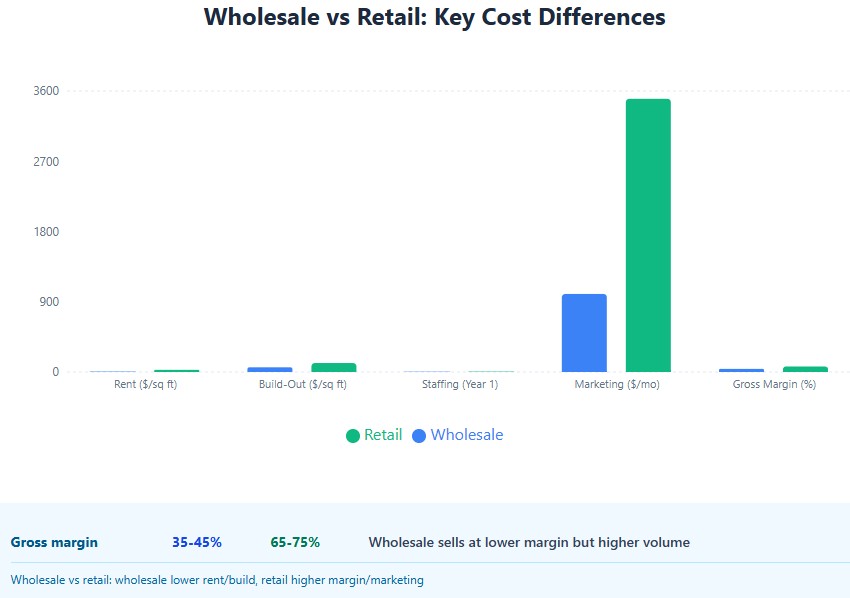
Wholesale vs. Retail: Key Cost Differences
| Cost Category | Wholesale Bakery | Retail Bakery & Cafe | Why the Difference? |
|---|---|---|---|
| Location rent (per sq ft) | $3-8/sq ft (industrial) | $15-40/sq ft (retail) | Retail needs foot traffic; wholesale just needs space |
| Build-out cost | $40-80/sq ft | $80-150/sq ft | Retail needs customer-facing finishes, restrooms, seating |
| Equipment focus | High-volume production (large mixers, deck ovens) | Display cases, espresso machine, POS | Wholesale = production efficiency; Retail = customer experience |
| Staffing (Year 1) | 3-5 bakers + 1 driver | 2-3 bakers + 4-6 front-of-house | Retail needs baristas, cashiers, servers |
| Marketing spend | $500-1,500/month (B2B sales) | $2,000-5,000/month (consumer ads) | Wholesale = relationship sales; Retail = brand awareness |
| Gross margin | 35-45% | 65-75% | Wholesale sells at lower margin but higher volume |
Model 3: Retail Bakery & Cafe ($275,000 – $550,000)
What You’re Building
A full-service retail bakery with customer-facing space: display cases, seating, coffee service, and on-site production. This is the most capital-intensive model but also has the highest revenue potential and brand visibility.
Detailed Cost Breakdown
| Category | Item | Low Estimate | High Estimate | Notes |
|---|---|---|---|---|
| Legal & Permits | Business formation (LLC or S-Corp) | $300 | $2,000 | Attorney fees for complex operating agreements |
| Health department permits | $1,000 | $4,000 | Plan review, inspections, annual permits | |
| Liquor license (if serving wine/beer) | $0 | $15,000 | Varies wildly by state/city; some places capped | |
| Business insurance (general + product + workers’ comp) | $3,000 | $8,000 | Higher for retail due to customer traffic | |
| Location & Build-Out | Lease deposit (first + last + security) | $18,000 | $60,000 | 1,500-2,500 sq ft retail @ $15-40/sq ft NNN |
| Hood ventilation (Type 1 for kitchen) | $15,000 | $40,000 | 12-16 ft hood with fire suppression | |
| Plumbing (kitchen + customer restrooms) | $15,000 | $40,000 | 3-comp sink, hand sinks, restroom plumbing | |
| Electrical upgrades | $8,000 | $25,000 | 200-amp service, 220V for ovens, lighting | |
| HVAC (kitchen + customer area) | $10,000 | $30,000 | Must handle kitchen heat + customer comfort | |
| Interior build-out (floors, walls, lighting, seating) | $30,000 | $100,000 | Highly variable based on design quality | |
| Architect/designer fees | $5,000 | $20,000 | Required for permits in most cities | |
| Kitchen Equipment | Deck oven (2-3 deck) | $15,000 | $45,000 | Used: $8,000-$15,000; new: $25,000-$45,000 |
| Spiral mixer (60-80 quart) | $5,000 | $18,000 | Used Hobart: $6,000-$10,000 | |
| Planetary mixer (20-30 quart for pastries) | $3,000 | $10,000 | Used Hobart: $3,500-$6,000 | |
| Proofing cabinet | $4,000 | $15,000 | Retarder proofer for overnight fermentation | |
| Refrigeration (walk-in + undercounter) | $10,000 | $30,000 | Walk-in cooler + prep table coolers | |
| Dishwasher (commercial high-temp) | $3,000 | $8,000 | Required by health code | |
| Stainless tables, prep equipment | $4,000 | $10,000 | Work tables, shelving, sheet pan racks | |
| Smallwares (pans, tools, utensils) | $3,000 | $8,000 | Everything from bench scrapers to piping bags | |
| Pastry sheeter (optional but helpful) | $4,000 | $15,000 | For croissants, danishes; used: $5,000-$8,000 | |
| Front-of-House | Display cases (refrigerated bakery cases) | $8,000 | $25,000 | 6-10 ft of display space; used: $3,000-$6,000 each |
| POS system (hardware + software) | $2,000 | $6,000 | Square, Toast, or Lightspeed; includes terminals, printers | |
| Coffee equipment (espresso machine + grinder) | $8,000 | $25,000 | 2-group espresso machine + commercial grinder | |
| Furniture (tables, chairs, counter) | $5,000 | $20,000 | Highly variable; can save by buying used | |
| Signage (exterior + menu boards) | $2,000 | $8,000 | Exterior sign, window decals, interior menu boards | |
| Initial Inventory | Ingredients (flour, butter, sugar, coffee) | $5,000 | $12,000 | First 2-3 weeks of production |
| Packaging (boxes, bags, cups, napkins) | $2,000 | $6,000 | Custom branded packaging | |
| Retail items (coffee beans, merch) | $1,000 | $4,000 | Bagged coffee, branded mugs, t-shirts | |
| Marketing & Launch | Branding (logo, brand identity) | $2,000 | $8,000 | Professional designer; critical for retail success |
| Website (online ordering, catering inquiries) | $2,000 | $8,000 | Mobile-friendly, SEO-optimized | |
| Pre-opening marketing (social media, PR) | $2,000 | $8,000 | 3-month campaign before opening | |
| Grand opening event | $1,000 | $5,000 | Samples, promotions, local media outreach | |
| Working Capital | Operating reserve (4-6 months) | $50,000 | $150,000 | Covers rent, payroll, ingredients before cash flow positive |
| Contingency fund (15-20%) | $25,000 | $60,000 | For build-out overruns, delayed permits, slow start | |
| TOTAL STARTUP COST | $271,300 | $848,000 | ||
| REALISTIC RANGE (Most Launches) | $275,000 | $550,000 | Excludes extreme build-outs in NYC/SF | |
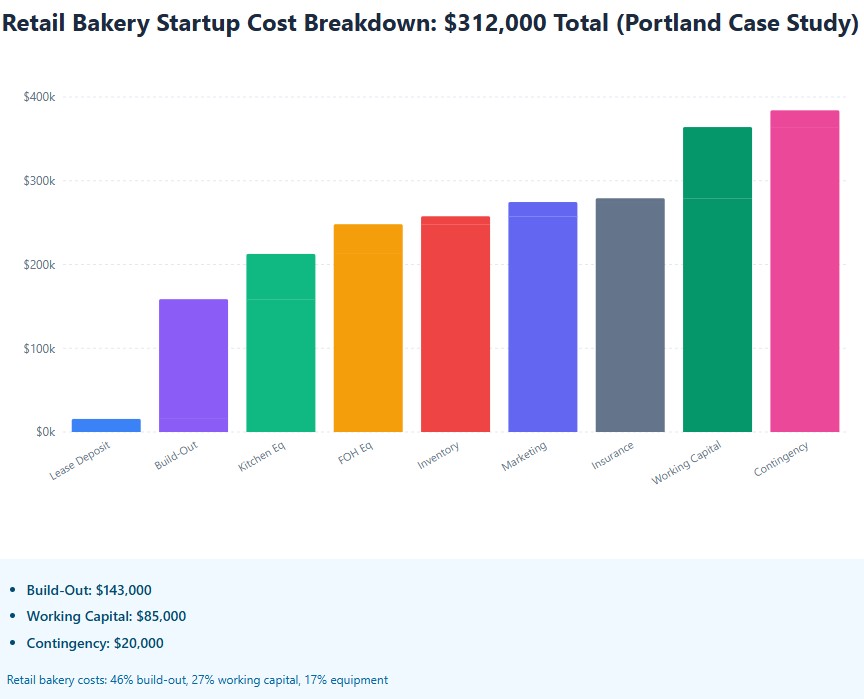
Real Case Study: Portland, OR Retail Bakery & Cafe
Business: “Flour & Flower Bakery” – neighborhood bakery with coffee service and seating for 24
Founders: Husband-wife team; she’s a pastry chef, he’s a former operations manager
Model: Retail bakery + cafe; 1,800 sq ft in trendy neighborhood
Total startup cost: $406,100
Breakdown:
- LLC formation + permits: $4,200
- Lease deposit (3 months @ $5,200/month): $15,600
- Hood ventilation (14 ft): $28,000
- Plumbing + electrical: $32,000
- HVAC: $18,000
- Interior build-out (floors, lighting, seating): $65,000
- Architect fees: $8,500
- Used deck oven (2-deck): $12,000
- Used spiral mixer (60qt): $7,500
- Planetary mixer (20qt): $4,200
- Retarder proofer: $8,000
- Walk-in cooler (used): $6,800
- Dishwasher + stainless tables: $7,500
- Smallwares: $4,800
- Display cases (2 refrigerated): $14,000
- POS system (Toast): $3,500
- Espresso machine (La Marzocco Linea) + grinder: $16,000
- Furniture (tables, chairs, counter): $12,000
- Signage: $4,500
- Initial inventory: $9,500
- Branding + website: $7,200
- Pre-opening marketing: $5,000
- Grand opening: $2,800
- Business insurance (annual): $4,500
- Working capital (5 months): $85,000
- Contingency: $20,000
Year 1 revenue: $520,000
Net profit margin: 12%
Break-even: Month 10
Key lesson: “We overspent on the espresso machine. Customers care more about the pastries. Could have saved $8,000 by buying a used machine or starting with drip coffee only.”
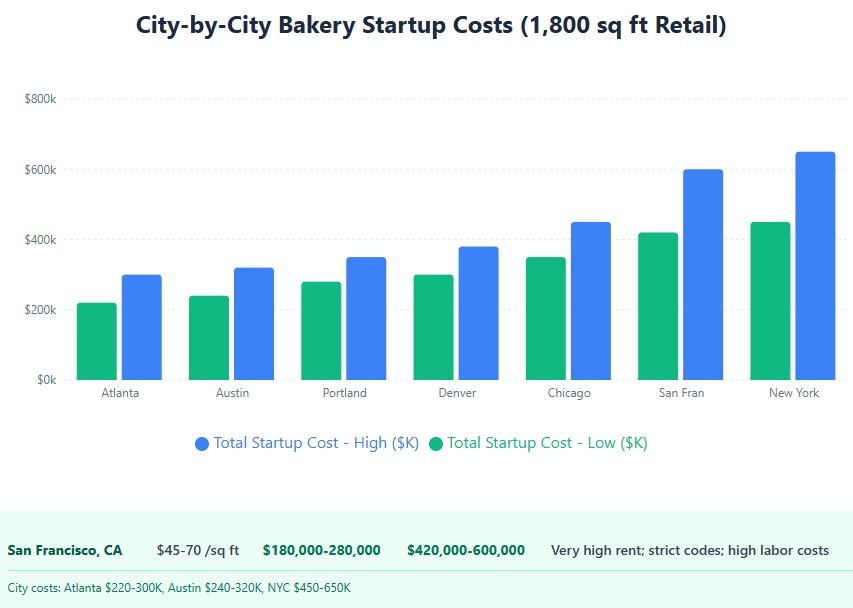
City-by-City Cost Comparison (Retail Bakery, 1,800 sq ft)
| City | Avg Rent ($/sq ft NNN) | Build-Out Cost | Total Startup (Mid-Range) | Key Cost Drivers |
|---|---|---|---|---|
| Portland, OR | $28-38 | $120,000-180,000 | $280,000-350,000 | Moderate rent; strict health codes; high labor costs |
| Austin, TX | $25-35 | $100,000-160,000 | $240,000-320,000 | No state income tax; rising rent; competitive market |
| Denver, CO | $30-42 | $130,000-190,000 | $300,000-380,000 | High rent; expensive labor; strong bakery culture |
| Atlanta, GA | $22-32 | $90,000-150,000 | $220,000-300,000 | Lower rent; lower labor costs; growing market |
| Chicago, IL | $35-50 | $150,000-220,000 | $350,000-450,000 | High rent; union labor; expensive permits |
| New York, NY (Brooklyn) | $50-80 | $200,000-300,000 | $450,000-650,000 | Extreme rent; union labor; complex permits |
| San Francisco, CA | $45-70 | $180,000-280,000 | $420,000-600,000 | Very high rent; strict codes; high labor costs |
The Hidden Costs Nobody Tells You About
Every bakery startup guide lists equipment and rent. But these are the costs that blow up budgets:
1. The “First-Year Loss” Reality
Most bakeries lose money for 4-10 months. You need cash to cover:
- Rent during ramp-up: You’ll pay $3,000-8,000/month in rent before hitting break-even sales
- Payroll before you’re busy: Staff costs $8,000-20,000/month even if sales are slow
- Ingredient waste: First 3 months, you’ll over-order and throw away $500-1,500/month in spoiled goods
- Marketing to build awareness: $2,000-5,000/month for 6+ months to build customer base
Total first-year loss (typical): $30,000-80,000
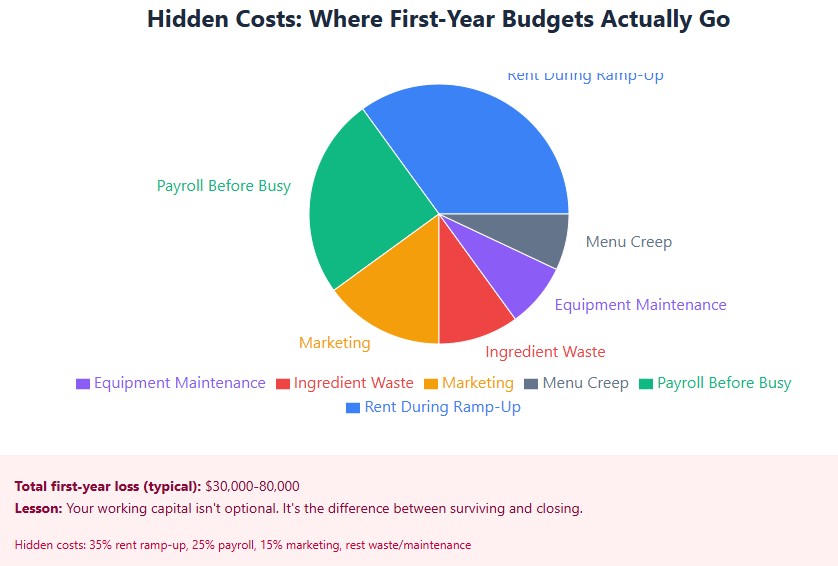 Lesson: Your working capital isn’t optional. It’s the difference between surviving and closing.
2. Equipment Maintenance & Replacement
Commercial equipment breaks. Budget for:
- Annual maintenance: $2,000-5,000 (oven servicing, refrigeration repairs, hood cleaning)
- Emergency repairs: $1,000-4,000 per incident (compressor failure, motor replacement)
- Small tool replacement: $500-1,500/year (sheet pans warp, mixers need parts)
Pro tip: Set aside 2-3% of equipment value annually for maintenance. If you spent $80,000 on equipment, budget $1,600-2,400/year.
3. The “Menu Creep” Problem
New bakery owners often start with 15-20 items, then add more. Each new item requires:
- New ingredients (minimum orders: $50-200 per item)
- New packaging (if applicable)
- Recipe testing time (unpaid labor)
- Staff training
Cost of adding 10 new items: $2,000-5,000 in ingredients, packaging, and testing time
Lesson: Start with 8-12 core items. Master them. Add slowly based on customer demand.
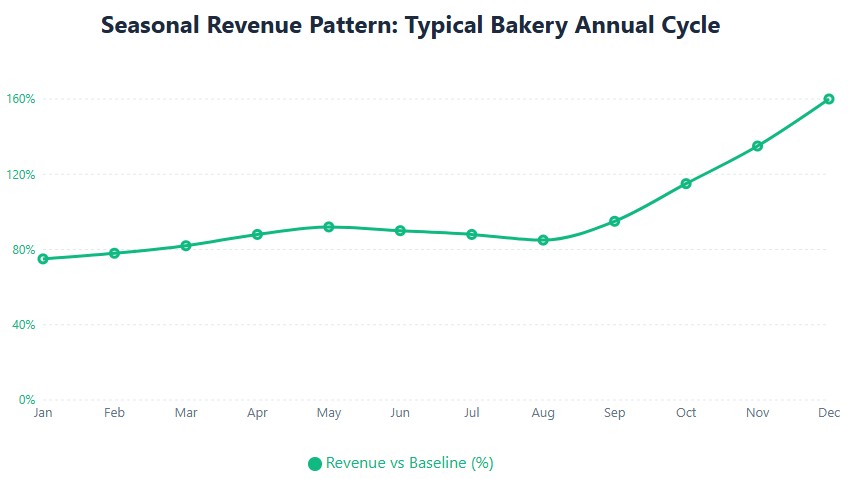
4. Seasonal Revenue Swings
Bakeries are seasonal. Expect:
- Q4 (Oct-Dec): +30-60% revenue (holiday orders, catering)
- Q1 (Jan-Mar): -20-40% revenue (post-holiday slump, cold weather)
- Summer: -10-20% revenue (vacations, lighter eating)
Cash flow impact: You’ll make extra in Q4 but need to stretch it through Q1. Budget accordingly.
5. The “Landlord Surprise”
Commercial leases include costs beyond base rent:
- CAM charges (Common Area Maintenance): $2-8/sq ft/year for shared parking, landscaping, security
- Property tax increases: Landlord passes through tax hikes (2-5% annually)
- Insurance increases: Landlord’s insurance costs passed to tenants
Total “NNN” costs: Add 15-30% to base rent. If rent is $5,000/month, expect to pay $5,750-6,500/month total.
Break-Even Analysis: How Many Pastries Do You Need to Sell?
Before you open, calculate your break-even point. Here’s the formula:
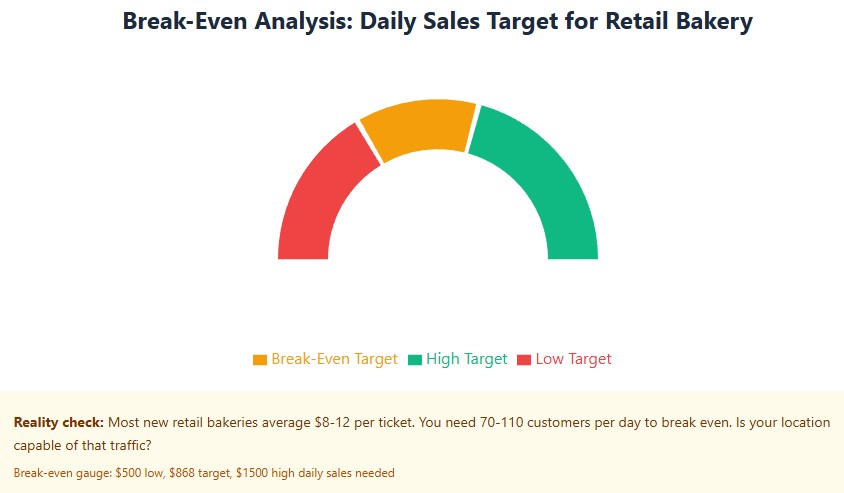
Break-Even Sales = Fixed Costs ÷ Gross Margin %
Example: Retail Bakery & Cafe
| Category | Monthly Cost |
|---|---|
| Fixed Costs: | |
| Rent (1,800 sq ft @ $30/sq ft) | $5,400 |
| Utilities (electric, gas, water) | $1,200 |
| Insurance | $400 |
| Software (POS, accounting) | $200 |
| Base payroll (manager + 1 baker) | $8,000 |
| Loan payment | $2,500 |
| Total Fixed Costs | $17,700 |
| Gross Margin | 68% |
| Break-Even Sales | $26,029/month |
What does $26,029/month look like?
- If average ticket is $8: 3,254 transactions/month (108/day)
- If average ticket is $12: 2,169 transactions/month (72/day)
- If average ticket is $15: 1,735 transactions/month (58/day)
Reality check: Most new retail bakeries average $8-12 per ticket. You need 70-110 customers per day to break even. Is your location capable of that traffic?
Break-Even by Model
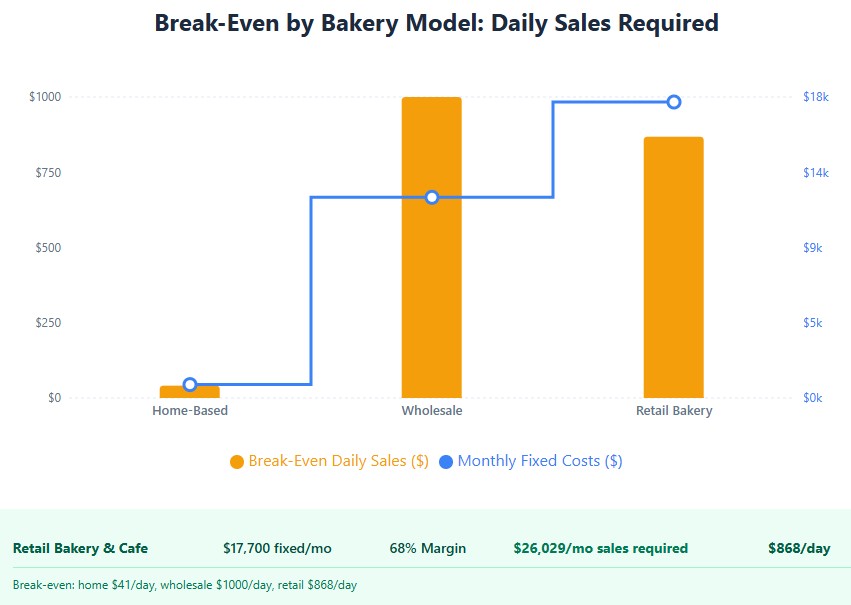
| Model | Monthly Fixed Costs | Gross Margin | Break-Even Sales | Daily Sales Needed |
|---|---|---|---|---|
| Home-Based / Cottage | $800 | 65% | $1,231 | $41/day |
| Wholesale Production | $12,000 | 40% | $30,000 | $1,000/day |
| Retail Bakery & Cafe | $17,700 | 68% | $26,029 | $868/day |
Funding Your Bakery: Where Does the Money Come From?
1. Personal Savings (Most Common)
Typical contribution: 20-50% of total startup costs
Pros: No debt, full control
Cons: Personal financial risk, limited by savings
2. SBA 7(a) Loans (Best for Retail Bakeries)
Loan amount: Up to $5 million (most bakery loans: $100,000-500,000)
Down payment: 10-20% required
Interest rate: Prime + 2.5-3.5% (currently 8.5-10.5%)
Term: 10 years for working capital, 25 years for real estate
Timeline: 60-90 days to approve
Requirements:
- Strong personal credit (680+)
- 2+ years industry experience (or experienced partner)
- Detailed business plan with financial projections
- Collateral (equipment, personal assets)
3. Equipment Financing (Best for Wholesale)
Loan amount: Up to 100% of equipment cost
Down payment: 0-20%
Interest rate: 6-12%
Term: 3-7 years (matches equipment life)
Pros: Equipment is collateral, easier to qualify
Cons: Higher rates than SBA loans
4. Investors / Partners (Best for Scaling)
Typical structure: Silent partner contributes 30-50% capital for 20-40% equity
Pros: No debt, shared risk
Cons: Loss of control, profit sharing, potential conflicts
5. Crowdfunding / Community Investment (Emerging Option)
Platforms: Wefunder, Mainvest, Localstake
Typical raise: $50,000-250,000
Structure: Revenue share (5-10% of revenue until 1.5-2x invested) or equity
Pros: Builds community, marketing benefit
Cons: Regulatory complexity, ongoing reporting
Funding Mix Example: $300,000 Retail Bakery
| Source | Amount | % of Total | Terms |
|---|---|---|---|
| Personal savings | $90,000 | 30% | Equity (no repayment) |
| SBA 7(a) loan | $180,000 | 60% | 10-year term, 9.5% interest, $2,340/month |
| Equipment financing | $30,000 | 10% | 5-year term, 8% interest, $608/month |
| TOTAL | $300,000 | 100% |
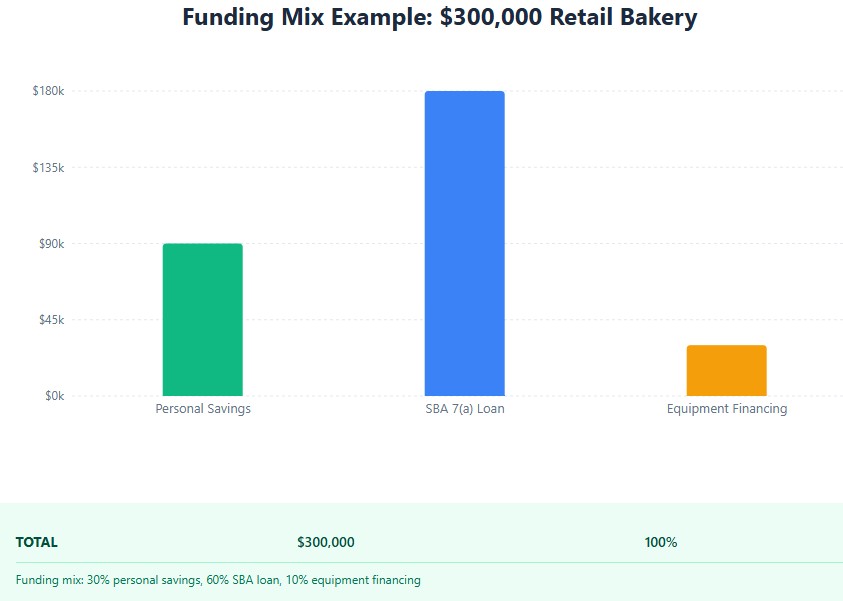
Monthly debt service: $2,948
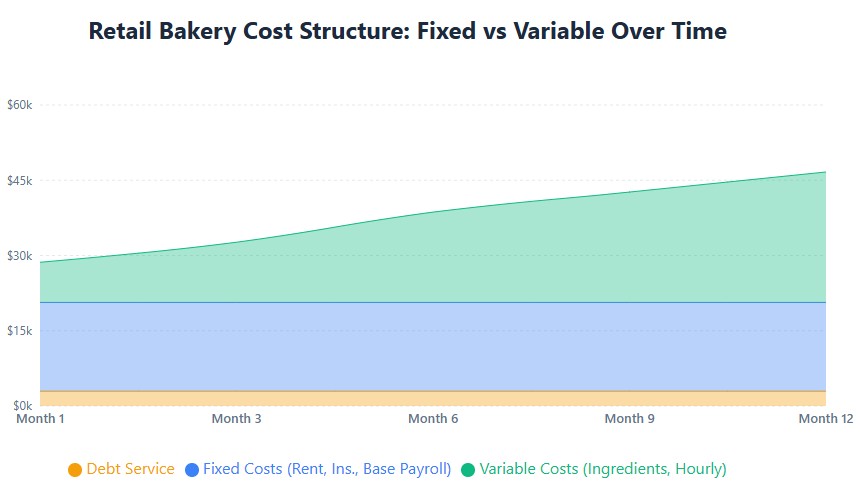
Key lesson: Don’t over-leverage. If your break-even sales are $26,000/month, you can’t afford $5,000/month in loan payments. Keep debt service under 10-12% of projected revenue.
Step-by-Step: How to Build Your Bakery Budget
Step 1: Choose Your Model (Week 1)
Decide: Home-based, wholesale, or retail? This determines everything else.
Step 2: Get Real Quotes (Weeks 2-4)
Don’t guess. Get actual numbers:
- Rent: Tour 5-10 spaces, get lease quotes (include NNN costs)
- Equipment: Get 3 quotes from restaurant supply dealers (new and used)
- Build-out: Get 3 contractor bids for your target space
- Insurance: Get quotes from 2-3 brokers
Step 3: Build Your Spreadsheet (Week 5)
Create a detailed budget with:
- One-time startup costs (equipment, build-out, permits)
- Monthly fixed costs (rent, insurance, base payroll)
- Monthly variable costs (ingredients, hourly labor, packaging)
- Working capital (4-6 months of fixed costs)
- Contingency (15-20% of total)
Step 4: Calculate Break-Even (Week 5)
Use the formula above. How many customers/sales do you need per day? Is that realistic for your location?
Step 5: Secure Funding (Weeks 6-12)
Apply for loans, find investors, or save more. Don’t sign a lease until funding is committed.
Step 6: Validate with a CPA (Week 12)
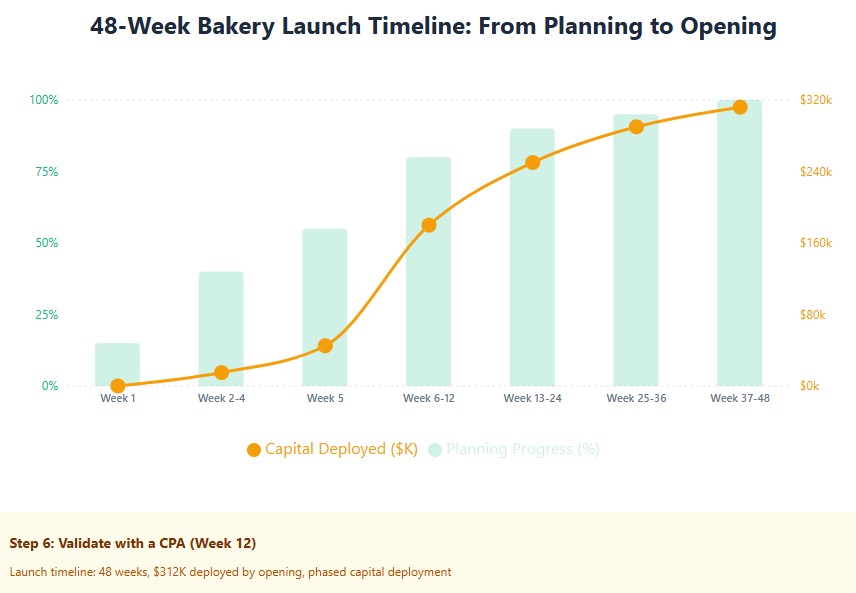
Hire a CPA with restaurant/bakery experience. Pay $500-1,500 for a review. They’ll catch mistakes that could cost you tens of thousands.
Final Reality Check: Can You Afford This?
Before you commit, ask yourself:
- Do I have 6+ months of personal living expenses saved? You won’t pay yourself for 6-12 months.
- Can I afford to lose this money? 60% of restaurants fail within 3 years. Are you prepared for that risk?
- Do I have industry experience? If not, can you partner with someone who does?
- Is my location capable of break-even sales? Count foot traffic. Talk to neighboring businesses. Be realistic.
- Do I have a financial buffer? If sales are 30% below projections for 6 months, can you survive?
If you answered “no” to any of these, pause. Get more capital, more experience, or reconsider your model.
Next Steps: Free Resources
- Bakery Business Plan Template: https://www.soccash.com/business-entrepreneurship/bakery-business-plan/
- SCORE Free Mentorship: score.org – Free business mentoring from retired executives
- Local Health Department: Google “[your city] health department food service” for permits and requirements
Starting a bakery is hard. But with realistic numbers, adequate capital, and a solid plan, it’s possible. Don’t let passion override prudence. Build your budget first, then chase your dream.