1. Executive Summary
The Executive Summary is the only section some lenders will read in detail. It must be punchy, data-driven, and explicitly state the funding ask.
- Business Name: The Rustic Spoon, LLC
- Concept: Fast-casual, counter-service restaurant focusing on locally sourced grain bowls, artisan sandwiches, and craft beverages. No tipping, no full table service.
- Location: 2,200 sq. ft. end-cap unit in the [Name] Mixed-Use Development, [City, State]. Co-tenanted with a major grocery anchor.
- Legal Structure: LLC, electing S-Corp taxation in Year 2.
- Total Startup Capital Required: $385,000
- Funding Request: $275,000 SBA 7(a) Loan + $110,000 Owner Equity Injection
- Projected Break-Even: Month 7 of operations
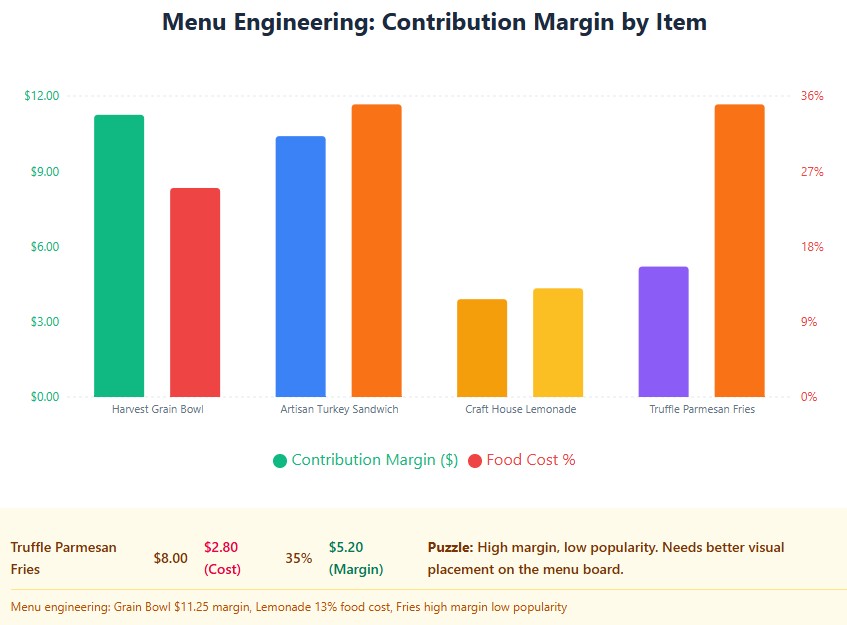
- Projected Year 1 Revenue: $890,000
- Target Prime Cost (Year 1): 58% (Industry benchmark: 60-65%)
The Opportunity: The target trade area has 18,000 daytime office workers and a 12% year-over-year residential growth rate. Currently, the area is saturated with slow, traditional sit-down restaurants (45+ minute lunch waits) and low-quality national fast-food chains. The Rustic Spoon fills the whitespace for high-quality, sub-8-minute lunch service with a projected average check of $17.50.
2. Company Overview & Concept
Mission and Vision
Mission: To provide busy professionals and families with chef-driven, nutritious meals in under 8 minutes, without compromising on ingredient quality or sustainability.
Vision: To become the dominant fast-casual lunch provider in the metro area, proving the model is scalable to 3-5 additional locations within 5 years.
The “Fast-Casual” Financial Advantage
We deliberately chose the fast-casual model over full-service dining. This is a financial decision, not just a branding one. By utilizing a counter-service model, we eliminate the need for front-of-house servers, reducing our target labor cost from the industry average of 35% (full-service) to a highly defensible 28-30%. Furthermore, the lack of a tipping model allows us to display transparent, all-inclusive pricing, which improves guest experience and simplifies payroll accounting.
3. Market Analysis & Hyperlocal Validation
Generic plans claim “there is high demand.” A fundable plan proves it with local data.
Target Market Segments
- The “Lunchtime Professional” (60% of weekday revenue): Ages 25-55, household income $85K+. Values speed, dietary transparency (gluten-free, vegan options), and digital ordering. Willing to pay a 15% premium for quality.
- The “Weekend Family” (70% of weekend revenue): Local residents seeking a casual, clean environment for a quick family meal without the formality or high cost of a sit-down restaurant.
Competitive Matrix
| Competitor | Distance | Avg. Check | Service Style | Their Weakness / Our Advantage |
|---|---|---|---|---|
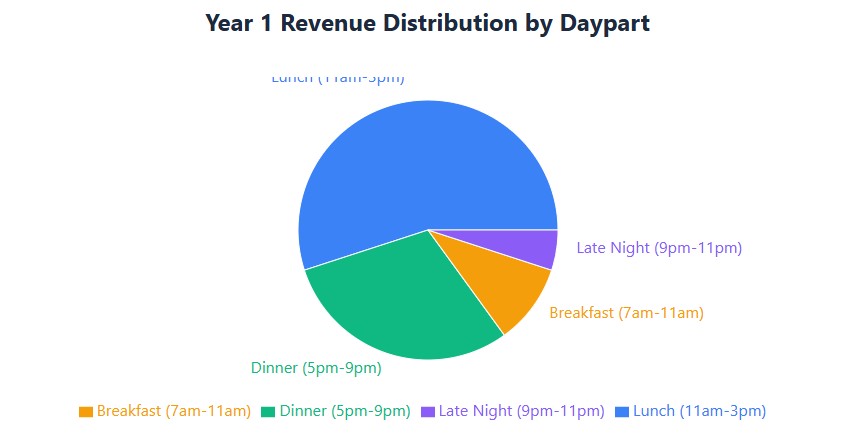
| The Local Bistro | 0.3 miles | $28.00 | Full Service | Weakness: 45-min lunch wait, high price. Our Edge: Sub-8 min service, $17.50 check. |
| National Salad Chain | 0.5 miles | $14.00 | Fast Casual | Weakness: Perceived as low-quality, cold food. Our Edge: Chef-driven, warm, locally sourced ingredients. |
| Food Truck Cluster | 0.2 miles | $12.00 | Mobile | Weakness: Weather-dependent, no seating. Our Edge: Climate-controlled, 65-seat dining room, reliable hours. |
4. Menu Strategy & Operations
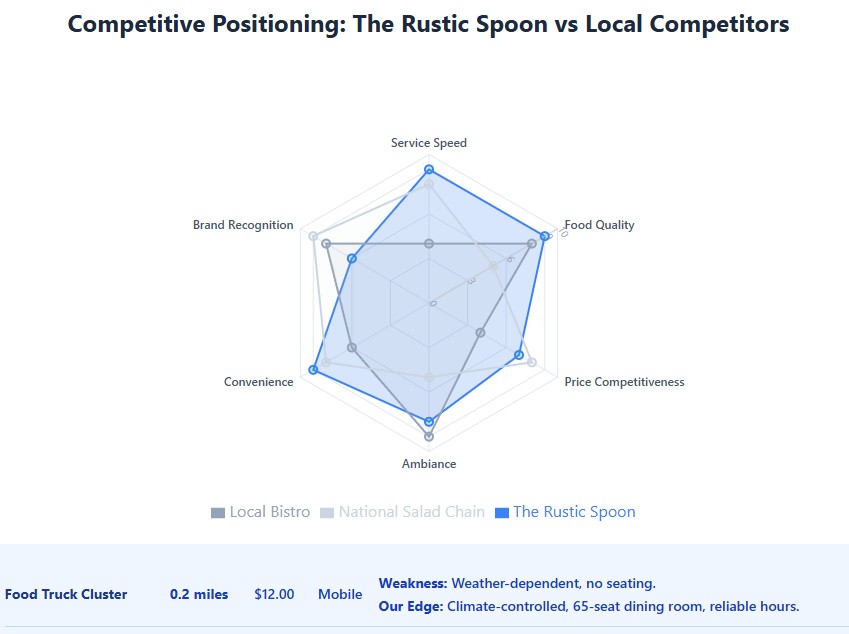
A menu is not a list of food; it is a financial engine. We have engineered our menu using the “Stars, Plowhorses, Puzzles, Dogs” matrix to maximize contribution margin.
Menu Engineering Snapshot
| Menu Item | Selling Price | Food Cost | Food Cost % | Contribution Margin | Strategic Action |
|---|---|---|---|---|---|
| Harvest Grain Bowl | $15.00 | $3.75 | 25% | $11.25 | Star: High margin, high popularity. Place at top of menu board. |
| Artisan Turkey Sandwich | $16.00 | $5.60 | 35% | $10.40 | Plowhorse: High popularity, lower margin. Keep, but train staff to upsell high-margin sides. |
| Craft House Lemonade | $4.50 | $0.60 | 13% | $3.90 | Star: Extreme margin. Implement “Would you like to add a drink?” script at POS. |
| Truffle Parmesan Fries | $8.00 | $2.80 | 35% | $5.20 | Puzzle: High margin, low popularity. Needs better visual placement on the menu board. |
Technology & Operations Stack
Modern restaurants run on software. Our tech stack is chosen to minimize labor hours and prevent inventory shrinkage:
- POS & KDS: Toast POS with Kitchen Display Systems to eliminate paper tickets and reduce order errors by an estimated 15%.
- Labor Management: 7shifts for automated, demand-based scheduling to prevent overstaffing during unpredictable lulls.
- Inventory & Procurement: MarketMan to track theoretical vs. actual food cost weekly, flagging waste or theft immediately.
5. Management & Organization
Lenders invest in people, not just ideas. A common red flag is an owner who plans to be the head chef, general manager, and bookkeeper on day one. This plan separates operational duties.
- Managing Partner (Owner): [Your Name]. 8 years of multi-unit restaurant management experience. Responsible for P&L oversight, vendor negotiations, marketing, and financial reporting. Will not work the line.
- Kitchen Manager: [Name/To Be Hired]. 10 years of high-volume culinary experience. Responsible for food quality, kitchen staff scheduling, inventory ordering, and health code compliance.
- Advisory Team: Retained local CPA (for monthly financial reviews and tax strategy) and a restaurant-specific attorney (for lease negotiation and employment law compliance).
6. Marketing & Launch Strategy
Customer acquisition will be rolled out in three distinct phases to manage cash flow and operational stress.
- Phase 1: Pre-Opening (Months -2 to 0): Focus on digital footprint. Claim and optimize Google Business Profile. Launch a “Founding Member” email capture campaign offering a free beverage on opening day. Goal: 1,000 local email addresses before doors open.
- Phase 2: Soft Opening (Weeks 1-2): Invite-only service for friends, family, and local office managers at 50% capacity. This is a stress test for the kitchen and POS, not a revenue generator. Staff are paid, but marketing spend is zero.
- Phase 3: Grand Opening & Retention (Month 2+): Activate local geo-fenced Meta/Instagram ads targeting the 1-mile radius. Launch a digital punch-card loyalty program within the POS to drive the crucial second and third visits.
7. Financial Plan (The Core)
This is the most critical section. The numbers below are conservative, reflecting a realistic ramp-up period rather than an unrealistic “hockey stick” growth curve.
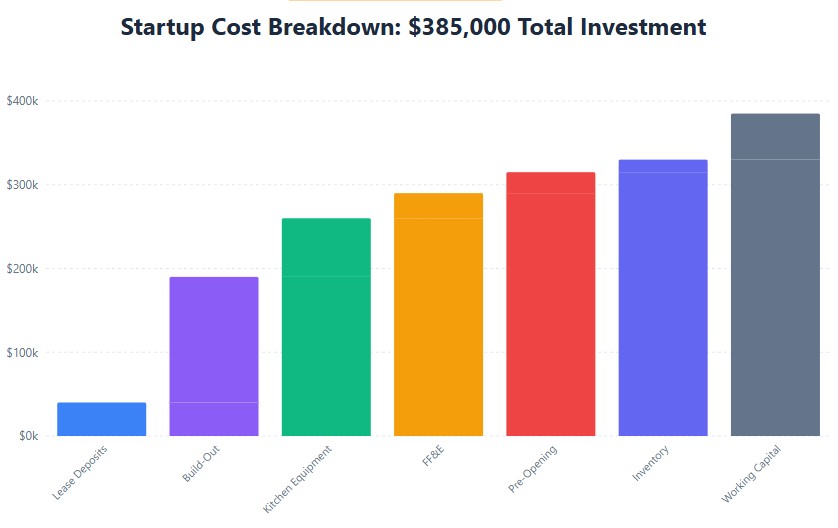
7.1 Detailed Startup Costs & Use of Funds
Notice the risk-based contingency. A flat 10% buffer is amateurish. We allocate contingency based on specific risk categories.
| Category | Estimated Cost | Risk & Notes |
|---|---|---|
| Lease Deposits | $40,000 | First, last, and security deposit (based on $35/sq ft NNN lease). |
| Build-Out & Construction | $150,000 | HVAC, plumbing, grease trap, flooring. Includes 15% contingency for hidden structural issues. |
| Kitchen Equipment | $70,000 | Refrigeration, cooking line, dish pit. Mix of new and refurbished. Includes 5% contingency for shipping delays. |
| FF&E (Furniture, Fixtures, Equipment) | $30,000 | Tables, chairs, POS hardware, sound system, exterior signage. |
| Pre-Opening Expenses | $25,000 | Licenses/permits (health, fire, signage), initial marketing, legal/accounting fees, staff training wages. |
| Opening Inventory | $15,000 | Initial food, beverage, and paper goods stock. |
| Working Capital Reserve | $55,000 | Covers 3-4 months of rent, base payroll, and utilities before reaching cash-flow positivity. Non-negotiable. |
| TOTAL STARTUP CAPITAL REQUIRED | $385,000 |
7.2 Year 1 Profit & Loss Projection (Summary)
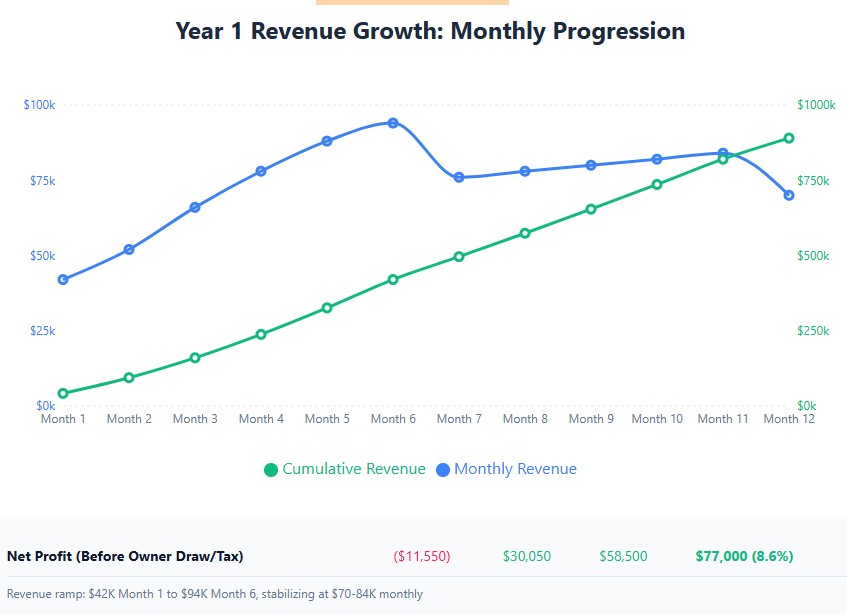
| Metric | Months 1–3 (Ramp Up) | Months 4–6 (Stabilizing) | Months 7–12 (Mature) | Year 1 Total |
|---|---|---|---|---|
| Gross Revenue | $160,000 | $260,000 | $470,000 | $890,000 |
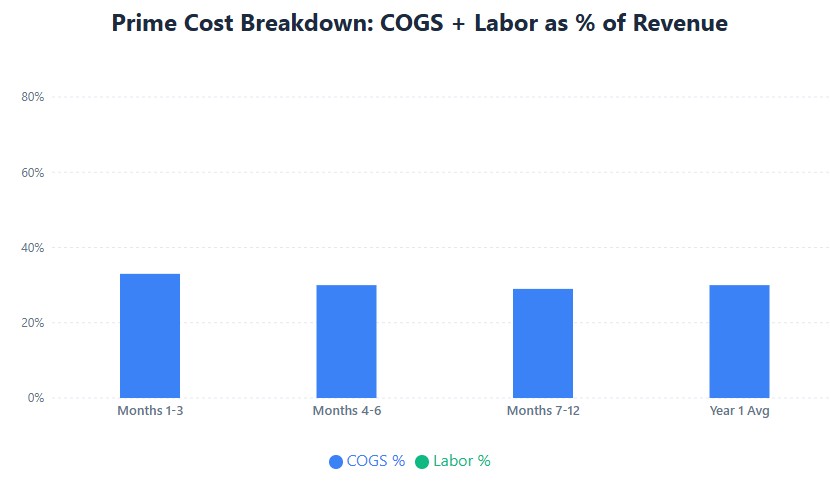
| Cost of Goods Sold (COGS) | $52,800 (33%) | $78,000 (30%) | $136,300 (29%) | $267,100 (30%) |
| Gross Profit | $107,200 | $182,000 | $333,700 | $622,900 |
| Labor Costs (incl. payroll taxes) | $56,000 (35%) | $83,200 (32%) | $145,700 (31%) | $284,900 (32%) |
| PRIME COST (COGS + Labor) | 68% | 62% | 60% | 62% |
| Occupancy (Rent/CAM/Trash) | $22,500 | $22,500 | $45,000 | $90,000 (10.1%) |
| Other OpEx (Marketing, Utilities, Repairs) | $32,000 | $38,000 | $68,000 | $138,000 (15.5%) |
| EBITDA | ($3,300) | $38,300 | $75,000 | $110,000 (12.3%) |
| Loan Debt Service (Principal + Interest) | $8,250 | $8,250 | $16,500 | $33,000 |
| Net Profit (Before Owner Draw/Tax) | ($11,550) | $30,050 | $58,500 | $77,000 (8.6%) |
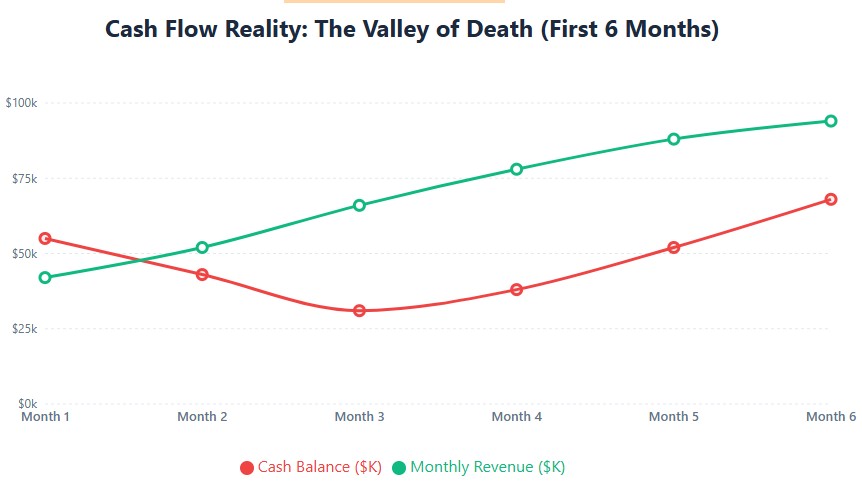
7.3 The “Valley of Death” Cash Flow Reality Check
A P&L is not a cash flow statement. Many profitable restaurants go bankrupt due to cash flow timing. This plan explicitly models three hidden cash traps:
- The Credit Card Holdback: Processors often hold 5–10% of sales for the first 90 days as a reserve. If we do $50,000 in Month 2 sales, we may only see $45,000 in the bank, but we still have to pay $50,000 worth of bills. Our $55,000 working capital reserve covers this gap.
- Vendor Terms vs. Payroll: Food vendors may demand Net-15 or Cash-on-Delivery (COD) for new accounts. Meanwhile, staff expects to be paid weekly. We have modeled a 2-to-3 week cash gap that must be funded from reserves.
- The “Free” Amortization Trap: Giving away “free” bread or chips that costs $1.50 per table, multiplied by 80 tables a day, is $120/day or $3,600/month straight off the bottom line. This is explicitly budgeted in “Other OpEx.”
7.4 Break-Even Analysis
We do not use vague “cover counts” for break-even. We use contribution margin.
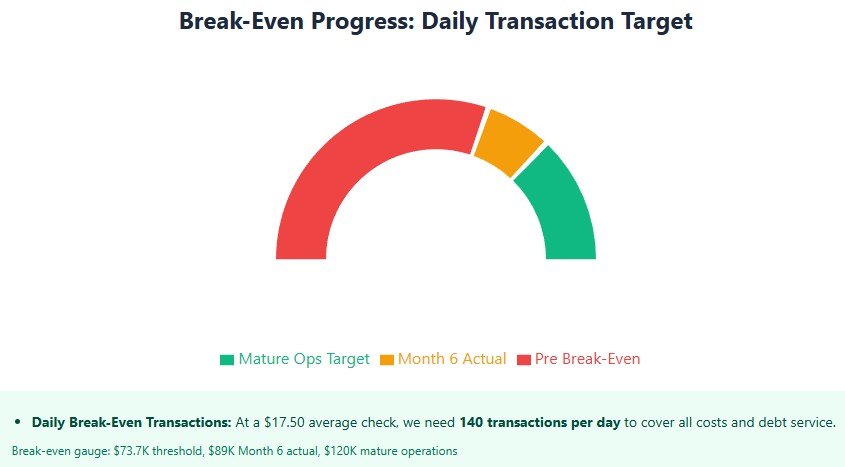
- Average Monthly Fixed Costs: $28,000 (Rent, base management salary, insurance, utilities, loan payment).
- Average Variable Cost %: 62% (Prime Cost: 30% COGS + 32% Labor).
- Contribution Margin: 38% (100% – 62%).
- Monthly Break-Even Revenue: $28,000 ÷ 0.38 = $73,684 per month (or ~$2,456 per day).
- Daily Break-Even Transactions: At a $17.50 average check, we need 140 transactions per day to cover all costs and debt service.
7.5 Stress Testing Scenarios
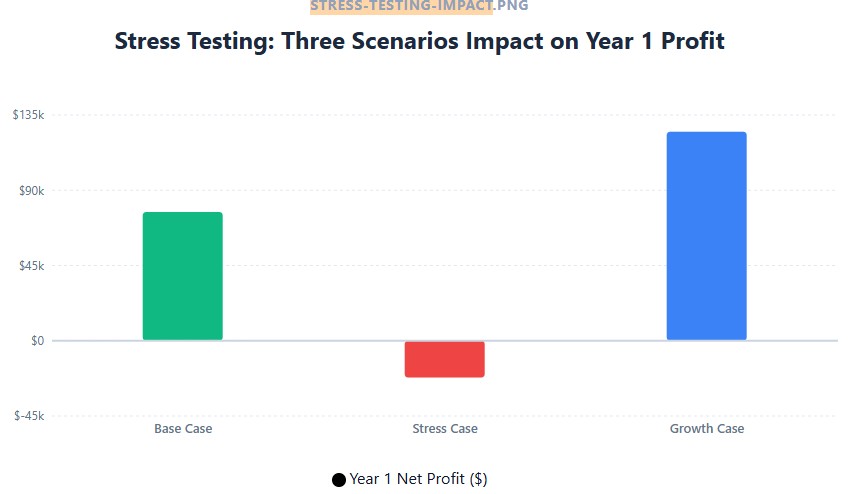
Lenders want to know what happens when things go wrong. We have modeled three scenarios:
| Scenario | Key Assumptions | Impact on Year 1 Net Profit | Mitigation Strategy |
|---|---|---|---|
| Base Case | 30% food cost, 32% labor, 8.6% net profit | $77,000 | Execute standard operating procedures. |
| Stress Case | Food costs rise to 34% (inflation), labor hits 36% (turnover), revenue is 15% lower. | ($22,000) Loss | Immediately cut manager hours, simplify menu to reduce waste, pause discretionary marketing spend. |
| Growth Case | Revenue is 15% higher due to strong word-of-mouth, labor scales efficiently to 30%. | $125,000 Profit | Accelerate loan payoff, begin saving for a second location or patio expansion. |
8. Next Steps: How to Use This Template
Copying and pasting this document will not get you funded. You must do the groundwork to make it yours:
- Get Real Contractor Bids: Do not guess your build-out cost. Call three local commercial general contractors and ask for a rough per-square-foot estimate for a restaurant build-out in your specific city. Use that number, not ours.
- Call Your Local Health Department: Ask for their specific permit fees, grease trap requirements, and inspection timeline. This varies wildly by county and can delay your opening by months, burning your working capital.
- Build a Dynamic Spreadsheet: Transfer the financial tables above into Excel or Google Sheets. Link the cells. If you change the “Average Check” from $17.50 to $18.00, the entire Year 1 P&L and break-even analysis should update automatically.
- Pre-Screen with a Lender: Before you sign a lease, take this draft to a local bank or SBA Preferred Lender. Ask them: “Based on this concept and these numbers, what holes do you see?” Their feedback is free and invaluable.
Final Reality Check
A business plan is not a static document you print, bind, and put in a drawer. It is a living financial dashboard. The most successful restaurant operators review their actual food cost, labor percentage, and prime cost every single week, comparing it to the projections in this plan, and adjust their purchasing or scheduling accordingly.
Plan for the worst, price for profit, and manage your cash flow like your business depends on it. Because it does.